

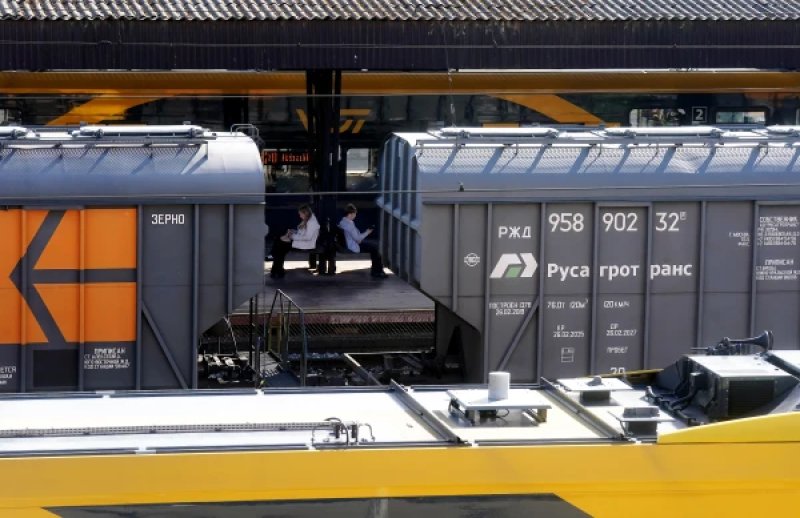
 Foto: BB.LV / вагоны с зерном
The head of the Ministry of Foreign Affairs, Baiba Braže, has prepared a draft Cabinet of Ministers regulations that envisage the introduction of national sanctions against the transit of grain from Russia and Belarus. Simply put, Latvia intends to independently prohibit the transportation of these goods across its territory, without waiting for a common decision from the European Union. So far, it has not been possible to achieve a ban at the EU level: other countries have shown no willingness to support this initiative. Therefore, the Latvian Ministry of Foreign Affairs proposes to act alone. The ministry acknowledges that such a step could lead to legal disputes due to existing contracts, losses for transport companies, and a reduction in budget revenues. Moreover, it still needs to be ensured that the ban does not contradict EU legislation. However, the Ministry considers all these risks manageable and does not see them as an obstacle to making a decision. The political situation adds a particular piquancy to this determination. Braže, representing "New Unity," is likely spending her last days in the minister's chair. Prime Minister Andris Kulbergs has already agreed to form a new coalition with the "National Alliance," leaving "New Unity" out of the government. However, the task of preparing a version of national sanctions was assigned to Braže by Kulbergs himself on October 7. Now the Prime Minister must decide whether he is ready to accept the outgoing minister's proposal with all its financial implications. And the consequences will be quite significant. The TV3 program Nekā personīga gathered estimates from ministries and port enterprises that allow for a possible price of the ban. According to calculations by the Ministry of Transport and the Ministry of Economics, halting the transit of only Russian grain will cost the Latvian economy between 27 and 50 million euros annually. If Russia responds by completely stopping cargo transportation through Latvia, losses could range from 230 to 550 million euros per year. A separate story is the potential lawsuits. The Ministry of Transport estimates this risk at 180 million euros. However, this amount is not based on an examination of specific contracts: the ministry did not request the contracts themselves. The administration of the Liepaja port cites an even more impressive figure — over one billion euros in potential claims against the state. As Nekā personīga points out, this is almost ten times the annual turnover of all the port's companies. Therefore, it would be premature to perceive such an estimate as a fixed amount of future losses. There is also a risk of a dispute with the European Union. According to the Ministry of Justice, if Latvia violates European legislation and loses a case in the EU Court, it may face fines, including daily payments until the violation is rectified. Meanwhile, Russian grain continues to arrive at Latvian ports in huge quantities. According to the State Revenue Service, in the first ten months of this year, 1.115 million tons of Russian grain have been transited through Latvia — three times more than in the same period last year. The dynamics of recent months are particularly impressive. In August, 159 thousand tons were transported, in September — 347 thousand, and in October — already 425 thousand tons. Thus, the volume of transportation in just September and October exceeded the entire last year's transit of Russian grain. The largest grain terminal in Liepaja, Liepaja Bulk Terminal, processed almost 700 thousand tons of cargo in September and October — more than in the previous six months combined. But a sharp halt in transportation will also hit Latvian enterprises. The management of Liepaja Bulk Terminal informed Nekā personīga that to operate without losses, the terminal needs to process at least two million tons of cargo per year. Meanwhile, next year, the volume of Latvian grain is estimated at only 450-500 thousand tons. The terminal was also counting on Russian grain, products from processed Russian sugar beets and sunflowers, and cargo from Kazakhstan and other countries. The enterprise employs 320 people. In Ventspils, around 400 jobs were associated with the transshipment of such cargo last year. The problem is also that carriers are bound by existing contracts. Liepaja Bulk Terminal has contracts for Russian cargo that are valid until February 1, 2027. The state company LDz Cargo, which accounts for about 39% of Russian grain transportation, has separate contracts that are valid until the end of 2028. Therefore, the Ministry of Agriculture proposes to maintain existing contracts and provide for a transitional period. As a result, even a ban on entering into new contracts would not mean an immediate halt to grain transit. Kulbergs himself acknowledged at a recent farmers' protest in Jekabpils that he faced a difficult choice. "My conscience and beliefs are 100% on your side. But I also have to consider the budget and the risks of legal disputes. All of this will fall on your shoulders," he told the protesters. Farmers, in turn, argue that cheap Russian products undermine their competitiveness (although they do not remain in the country but are transited). Now the government must choose between the political demand to immediately stop Russian transit and the economic consequences of such a decision. Moreover, the cost of the ban remains a subject of dispute even among state institutions.
