

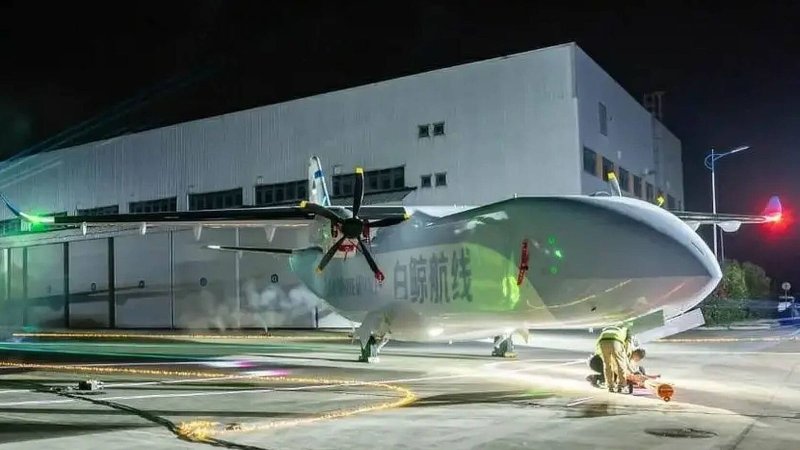
 Foto: EC
The world’s largest pilotless cargo aircraft has taken off for the first time. The W5000 can carry five tonnes autonomously, like the drones that deliver food in cities such as Shanghai. Last Saturday, it took off from Otog Front Banner General Airport in Inner Mongolia, climbed to 1,000 metres above the runway and landed about 30 minutes later.
Chinese company Air White Whale, founded in Beijing in September 2021, says moving one tonne of freight over one kilometre can cost at least 60% less than with a piloted aircraft of the same size. For now, that is a figure for the sales brochure. The cargo aircraft has only just completed a technical verification flight and does not yet have an airworthiness certificate.
Por qué este robot espacial es clave para el futuro de la humanidadJesús DíazEl proyecto ASTRA de Caltech sólo construyó una sección de una pequeña antena en el vacío del espacio. Es la primera demostración real del futuro de la colonización del sistema solar
What the W5000 is like
This prototype—called Longcheng 1—has a wingspan of 22.7 metres, almost the length of a tennis court, and a maximum takeoff weight of 10.8 tonnes. Its cargo hold, with a volume of more than 65 cubic metres, can accommodate standard air cargo containers and pallets carrying up to five tonnes of goods in total. Its maximum range with this full payload, the company says, is 2,600 kilometres—more than the distance between Madrid and Warsaw.
No one pilots Longcheng 1. Not even a remote pilot. The aircraft flies itself while a team on the ground watches to make sure nothing goes wrong. According to the company, that same team can supervise six or seven aircraft at once. If a problem arises, a pilot on the ground can fly the aircraft remotely.
According to Hu Zhendong, Air White Whale’s founder, chairman and CEO, the savings come from eliminating the crew. With no pilots, a company operating W5000 aircraft will save on salaries. And because the aircraft dispenses with the crewed cockpit—with all the electronics and mechanisms human pilots need—the W5000 weighs less and burns less fuel than an equivalent piloted aircraft.
The W5000 is equipped with two AEP100 engines, a 900-kilowatt turboprop designed and manufactured by China’s state-owned aircraft engine corporation, AECC. Everything on the aircraft is Chinese, Hu boasts: all 220,000 parts were manufactured in China.
Saturday’s flight was the first flight of the first prototype. Air White Whale had planned to certify the aircraft and start deliveries in 2026, but those targets have slipped. The company now says the aircraft will enter commercial service in late 2027. It also claims to have 835 orders, but these are not yet firm purchases.
China’s race to develop pilotless cargo aircraft
According to Song Zhongping, a researcher at the Xwon (Hong Kong) Technology Exchange Center, the aircraft’s first flight demonstrated that it can fly and that its propulsion, flight controls, avionics and data link work properly. Song sees a problem with the parts. There are 220,000 of them, sourced from different manufacturers. Getting them all to work together with the reliability aviation demands will be a major challenge, he says.
Imagen del vuelo. (Air White Whale)
The W5000 is just the latest entrant in China’s race to achieve automated cargo aviation. In 2022, AVIC flew its TP500, with a payload capacity of up to 500 kilograms. Another company, Tengden, flew another autonomous twin-engine aircraft capable of carrying two tonnes in August 2024. And Hunan Shanhe Huayu, another emerging aviation company, unveiled one with a payload capacity of 3,200 kilograms that same month.
Here in the US, we are falling behind once again. The American Skyreach from Skyways—unveiled a few days ago and still undergoing testing—can carry just 45 kilograms, including fuel. The W5000 carries more than 100 times that in freight alone.
Song believes autonomous aircraft can add freight capacity to China’s low-altitude economy, one of the major industrial sectors taking off, literally and figuratively, in the country. From food and product deliveries using small drones to large machines such as the W5000, Beijing is betting aggressively on automating logistics over short, medium and long distances.
