

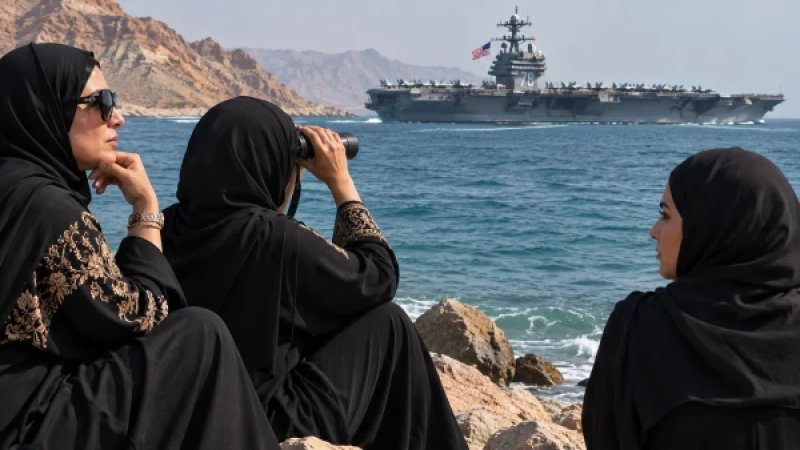
 Foto: BB.LV / Освобожденные женщины востока
The US and Iran have been exchanging increasingly large-scale airstrikes since Sunday as the escalation rapidly intensifies. According to the Islamic Revolutionary Guard Corps (IRGC), two more oil tankers exploded in the Strait of Hormuz on Monday, bringing the total number of vessels that have caught fire in the area since the beginning of the week to six. On Monday night, US military forces launched a new series of strikes against Iranian missile launchers in the south of the country. This was in response to attacks by Iranian forces on the US base in Bahrain and missile strikes on tankers in the Strait of Hormuz. The situation in the region sharply escalated with the arrival of the USS Theodore Roosevelt aircraft carrier, which joined two other carrier strike groups in the area of responsibility of the US Central Command (CENTCOM). On Sunday, Iran launched a drone strike on a radar station at the American Al-Riffa airbase. This followed attacks on US facilities in Bahrain the day before, as Tehran demonstrates strength in response to the buildup of American military presence. Reports of Iranian attacks on tankers in the Strait of Hormuz traditionally prompt an immediate reaction from Washington in the form of strikes against the coastal military infrastructure of the Islamic Republic. As a result, on Monday night, US forces struck Iranian launchers in the areas of Bandar Lengeh and Sirik in southern Iran. The geography of the strikes has expanded compared to previous rounds of the conflict, and the intensity of fire from both sides has noticeably increased. Flight tracking services have recorded a sharp increase in US Air Force activity over the Persian Gulf compared to previous weeks, as Washington continues to build up forces in the region. ## ## New Explosions of Tankers in the Strait of Hormuz On Sunday, the IRGC stated that two tankers attempting to pass through the southern route of the Strait of Hormuz under the direct guidance of American military forces detonated on naval mines that "lit up the sky for several hours," according to the Iranian agency Tasnim. The Corps described the incident as a response to the so-called "illegal blockade by the US" and a violation of Iranian navigation rules, once again warning oil companies that the southern fairway of the strait is mined. On Monday, the Iranian Navy reported that another "violating" oil tanker caught fire after colliding with a mine in a closed area east of the Strait of Hormuz and lost power. "Disabling tracking systems and unlawfully entering prohibited and unsafe maritime areas puts violating vessels at serious risk," the Iranian Navy stated. It remains unclear whether this tanker is among the six vessels that the IRGC reported as having caught fire or if it is a separate incident. The Iranian military's statements regarding the number of damaged vessels and the circumstances of the explosions have not received independent confirmation. At the same time, the UK Maritime Trade Operations (UKMTO) confirmed receiving reports of at least one incident early Monday morning: an oil tanker was struck by an "unidentified projectile" while exiting the Strait of Hormuz. "The impact caused a fire in the engine room," the UKMTO report noted. According to the agency, there were no casualties, the crew is safe, but "the assessment of damages and the extent of environmental harm remain unclear." Amid a series of incidents involving vessels in the Strait of Hormuz, global oil prices rose on Monday. ## ## The Third American Aircraft Carrier Arrives in the Middle East The USS Theodore Roosevelt aircraft carrier has entered the CENTCOM operational area, joining the USS George Washington and USS George H.W. Bush carrier strike groups. For the first time since the Iraq War, the US has concentrated three aircraft carriers in the Middle East. US military forces are completing a large-scale buildup of naval and air forces: about 19 combat ships of the US Navy, including cruisers and destroyers with guided missile weapons, are deployed in the region, including the Red Sea. Meanwhile, The Wall Street Journal, citing analysts from American intelligence, reports (although with low confidence in the exact figures) that Iran currently possesses an arsenal of 1,500 to 2,500 missiles, as well as new drones and short-range missiles. According to Israeli military estimates, Iran has about 1,500 ballistic missiles. On November 10, the IRGC published photographs allegedly showing the Chief of Staff of the Iranian Armed Forces and the commander of the IRGC Aerospace Force inspecting underground tunnels with missiles and launchers — referred to in Tehran as a new "missile city." Iranian authorities continue to threaten a tough response to the resumption of massive US strikes. On Sunday, military officials told the Iranian publication Tabnak News that "Iran's new offensive military doctrine means that the country will no longer be limited to calibrated retaliatory strikes and will break the cycle of escalation," threatening, among other things, American bases in Europe. US Secretary of State Marco Rubio sharply criticized the "Shia clergy of Iran" on Sunday: "Every problem in the Middle East, every major issue — whether it’s the Houthis attacking Saudi Arabia, Shia armed groups destabilizing Iraq, factions supporting Assad and the destruction of Syria, or Hezbollah in Lebanon — wherever you look, there is one common denominator: the Shia spiritual leaders of Iran and their expansionist thinking." "This is a serious historical threat that cannot be ignored," Rubio emphasized. Former head of the research department of Israeli military intelligence Dani Citrinovich wrote on social media X that "the current situation in the Strait of Hormuz is inherently unstable and cannot be sustained indefinitely," and that "the current dynamics push both sides toward escalation, even if neither wants a larger confrontation." "As long as the US maintains a naval blockade and attempts to guide tankers through the southern shipping route, Tehran will view these actions as an act of war," the expert noted. In his opinion, Iran will not indefinitely tolerate this situation and will seek to raise the cost of the blockade for Washington through new attacks on tankers and other targets — especially if US military operations continue in the area of Bandar Abbas. "There is a fundamental asymmetry between Washington and Tehran. The US may believe it can maintain the blockade for a long time, but Iran sees it as a direct threat to its economy, sovereignty, and national security. For the Iranian leadership, accepting the blockade without a response would mean accepting a new strategic reality imposed by Washington. The regime in Tehran simply does not operate that way," Citrinovich concluded.
