

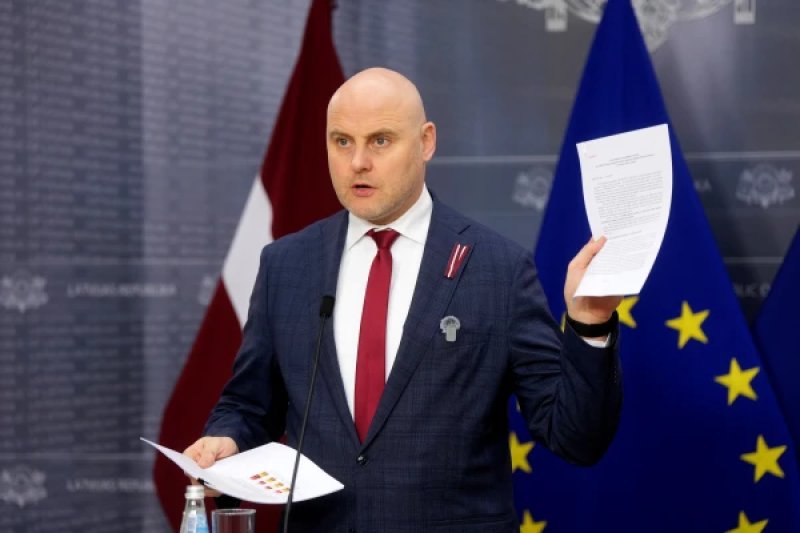
 Foto: BB.LV / Кулбергс
In the new government of Latvia, which Andris Kulbergs ("United List") intends to lead, several key ministries are planned to be handed over to non-partisan specialists. Among the proposed candidates are a banking economist, an experienced diplomat, and a former head of a large Riga hospital. At the same time, some ministers will retain their positions. According to the LETA agency, on Tuesday, November 17, Kulbergs presented the composition of the future cabinet and outlined its main tasks. The government is planned to be formed by the "United List" (UL) and the National Alliance (NA), which together hold 51 parliamentary mandates. ### **Who Will Get Key Ministries** Karls Purgailis, the chief economist of Citadele Bank, has been proposed for the position of Minister of Finance. He has been working in the financial sector for about 25 years, previously holding positions at Parex banka, SEB banka, and other credit institutions. Since 2024, Purgailis has been the chief economist of Citadele in Latvia. In addition, he is already advising Kulbergs on financial and economic issues as a freelance advisor. The Ministry of Health is proposed to be headed by Normunds Stanavičs, a board member of Amber Beverage Group and a former head of the Riga Eastern Clinical University Hospital. Over the years, Stanavičs has also chaired the board of Pauls Stradiņš Hospital, worked as the financial director of Ventspils nafta, and led food industry enterprises. Girts Jaunzems, Latvia's ambassador to Uzbekistan, has been nominated for the position of Minister of Foreign Affairs. He has been serving in the diplomatic service since 1999, holding various positions in the Ministry of Foreign Affairs and Latvian diplomatic missions abroad. ### **Among the Candidates Are Kulbergs' Classmate and Fellow Student** There are interesting coincidences in the biographies of some future ministers. For instance, candidate for the head of the Ministry of Foreign Affairs Girts Jaunzems studied in the same class as Kulbergs, while the candidate for the position of Minister of Health Normunds Stanavičs was his fellow student. The Ministry of Transport is proposed to be entrusted to Krists Lipšans, who is currently advising Kulbergs on legal matters. Lipšans is also a member of the board of the Automobile Association, with which the future prime minister has previously been associated, and worked as his assistant in the Saeima. Thus, among the proposed non-partisan candidates, there are not only industry specialists but also people already familiar to Kulbergs from studies or professional activities. ### **Who Will Retain Positions and Who Will Become New Ministers** Defense Minister Raivis Melniņš, a former colonel of the National Armed Forces, has agreed to continue working in the new cabinet. Interior Minister Jānis Dombrava and Culture Minister Nauris Puntulis, representing the National Alliance, are also expected to retain their positions. Edgars Tavars from the "United List" is planned to retain the Ministry of Smart Governance and Regional Development. The remaining ministries are proposed to be distributed as follows: - Ministry of Economics — Edgars Štelmahers (UL), Saeima deputy and entrepreneur, previously headed Cēsu alus. - Ministry of Education and Science — Česlavs Batņa (UL), Saeima deputy, former school director. - Ministry of Agriculture — Edgars Putra (UL), Saeima deputy and farmer. - Ministry of Justice — Viesturs Vītovskis (UL), current parliamentary secretary of the Ministry of Justice. - Ministry of Welfare — Ilze Indrikson (NA), party chairwoman, who previously held the positions of Minister of Economics and Minister of Education. The ministers will be able to assume their duties only after the government is approved by the Saeima. ### **The Ministry of Climate and Energy Is Planned to Be Reorganized** One of the first changes in the structure of government may be the reorganization of the Ministry of Climate and Energy. Kulbergs confirmed that he intends to start this process at the first stage of the government's work. Until the reorganization is completed, the prime minister plans to exercise political oversight over the relevant area independently. Among other priorities, he mentioned accelerating economic growth, increasing the efficiency of public administration, strengthening security, and reducing the time required for decision-making. In Kulbergs' opinion, a small coalition of two political forces will be able to act more quickly, as it will not have to coordinate decisions with a large number of partners. ### **The New Government Will Have Only One Spare Vote** The "United List" received 41 parliamentary mandates in the elections, while the National Alliance received ten. Thus, together they hold 51 votes — the minimum majority in the 100-seat Saeima. This means that for decisions requiring the support of a majority of all deputies, the coalition must maintain unity almost in full. Kulbergs explains the choice of a narrower coalition by the desire to accelerate reforms and avoid disagreements that hinder decision-making. ### **Kulbergs' Second Government in Six Months** Andris Kulbergs first headed the Latvian government in late May 2026 after the collapse of the previous coalition. In the parliamentary elections in the fall, his "United List" received 41 mandates, becoming the largest political force in the new Saeima. Now Kulbergs intends to form a second cabinet, in which not only party politicians but also invited specialists will play a significant role. The final decision on the composition of the government must be made by the Saeima.
