

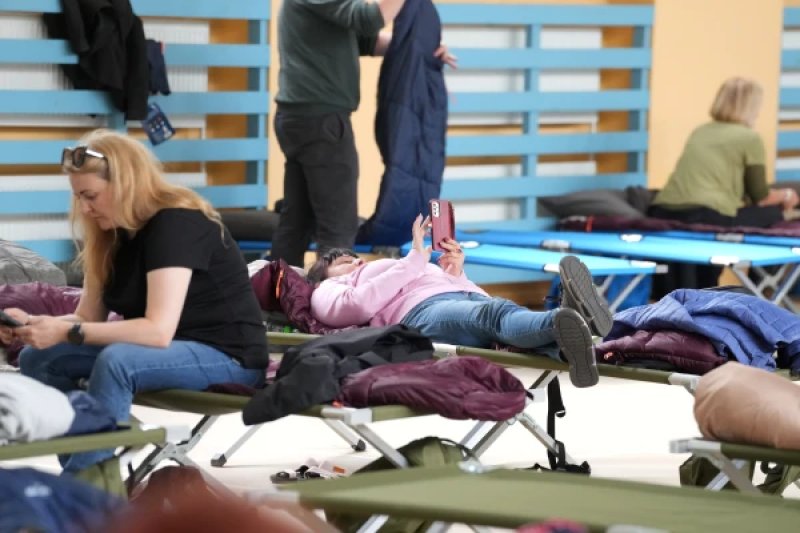
 Foto: BB.LV / Эвакуация
This was stated by Inese Vaivare, director of the Latvian Platform for Development Cooperation (LAPAS), at an event organized by Europe Direct Vidzeme for experience exchange between Latvian and Ukrainian experts, dedicated to strengthening societal resilience in crisis situations. LAPAS is a national platform uniting 47 non-governmental organizations that work on enhancing societal resilience and promoting sustainable global development. ### **“A person is not an object that can simply be moved”** Vaivare emphasized that the importance of the human factor is often underestimated by both state institutions dealing with civil defense issues and local governments. According to her, a person is not an object that can simply be transported from one place to another during a crisis. People should be at the center of the civil defense system, and the system itself should be built with their needs in mind. She mentioned that during her participation in various civil defense events and exercises, she encountered an attitude that can be expressed in the words: “Let them be glad that they are being moved at all.” In Vaivare's opinion, Latvia needs to actively work on changing such an approach, training staff of responsible institutions, and paying more attention to humane treatment of people. Moreover, local governments should establish real cooperation with non-governmental organizations and local communities that can assist in communication with the population during emergencies. ### **Latvians are used to waiting for someone to save them** Vaivare pointed out that in a crisis situation, the individual preparedness of each person will be of great importance. According to her, many in Latvia prefer to adhere to the common misconception: it is better not to think about a possible crisis, otherwise it will definitely happen. Instead of practical preparation, people often try to avoid the unpleasant topic. Additionally, many are accustomed to relying on the idea that in case of danger, someone will definitely come to their aid. Vaivare recommends starting preparation with small but concrete actions — for example, refreshing knowledge about emergency behavior rules and gradually gathering necessary supplies and items for a crisis. ### **Ukrainian experts shared what needs to be planned before a crisis** Ukrainian specialists participating in the event shared their experiences of actions in wartime conditions and discussed the problems faced by the population and civil protection services. In particular, they emphasized the necessity of planning food supplies in advance and creating fuel reserves. Special attention was given to equipping shelters. According to Ukrainian experts, shelters must ensure access to the internet and install automatic magnetic locks that open when an alarm is declared. This will allow people to reach a safe place more quickly and maintain communication during an emergency. ### **First aid training should take place before a crisis** Ukrainian specialists also recommended organizing training for the population in first aid skills in advance. They emphasized that such training should be conducted before an emergency arises, not when danger has already occurred. Moreover, experts suggested diversifying sources of energy supply, water, heat, and communication so that the failure of one system does not lead to a complete loss of vital services. Among other recommendations are the protection of critical infrastructure, storing data in three different locations, and creating resilient public spaces where residents can gather and receive assistance. Such places could be, for example, libraries. Experts also highlighted the importance of following cybersecurity rules and taking other measures to enhance society's ability to cope with crises.
