

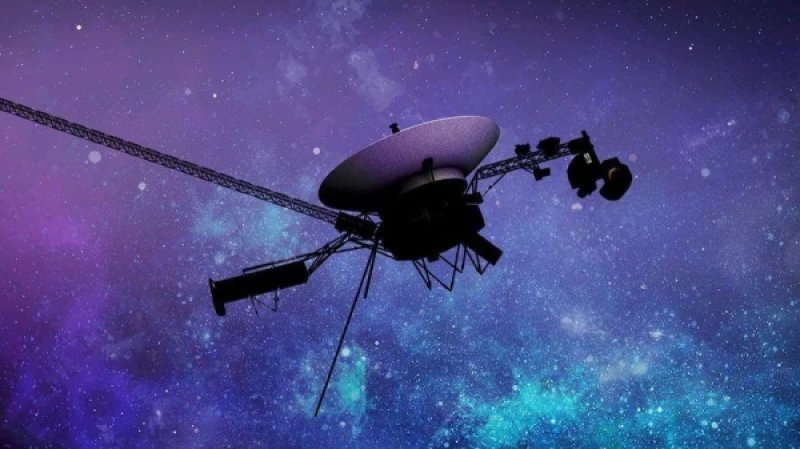
 Foto: BB.LV / Voyager 1
For the first time, a message from a man-made spacecraft has arrived from a distance exceeding one light day. As reported by the Spanish newspaper EL PAÍS, the historic signal was received by the 70-meter antenna DSS-63, located in Robledo de Chavela near Madrid. On November 18, Voyager 1 crossed the symbolic boundary of 25.902 billion kilometers from Earth. This is the distance that light and radio waves travel in 24 hours. According to NASA's calculations, the spacecraft reached this milestone at 11:16:07 Spanish time. The signal sent at that moment was expected to reach Earth the next day, November 19, at approximately 11:16:09. The additional two seconds are explained by the movement of the Earth, which has slightly moved away from the spacecraft during the travel time of the radio waves. At the designated moment, it was the Spanish station that could maintain communication with Voyager 1. The two other NASA network stations — in Goldstone, California, and Canberra, Australia — were in unsuitable positions relative to the spacecraft. According to EL PAÍS, at 11:16 on November 19, NASA's monitoring system showed an active reception of the Voyager 1 signal by the Madrid antenna. ## Almost Half a Century in Space Voyager 1 was launched on September 5, 1977. Initially, its mission was to explore Jupiter and Saturn, but after completing its primary objectives, the spacecraft continued its journey to the edges of the Solar System. In August 2012, it crossed the heliopause — the boundary of the region dominated by the solar wind — and entered interstellar space. Today, Voyager 1 remains the most distant human-made object from Earth. Despite its age, the spacecraft continues to transmit scientific data. However, maintaining communication with it is becoming increasingly difficult. Energy resources are gradually depleting, so NASA engineers have to turn off some equipment to extend the operation of the remaining instruments. ## **Now, a Response Takes More Than Two Days** Crossing the one light day threshold means that even radio signals traveling at the speed of light cannot ensure quick communication with the spacecraft. Commands from Earth now take more than 24 hours to reach Voyager 1. If the spacecraft immediately sends a response, its receipt will require more than another day. Thus, even the fastest exchange of commands and responses takes more than 48 hours. At the same time, NASA specialists continue to operate the spacecraft, which has been in interstellar space for almost half a century since its launch. The historic signal received in Spain has become another confirmation that Voyager 1 is still capable of maintaining communication with Earth at a distance that just recently seemed practically unreachable. Ahead of the spacecraft are new billions of kilometers of travel. But even now, each of its radio signals represents a message from the past — a message sent more than a day ago from the depths of interstellar space.
