

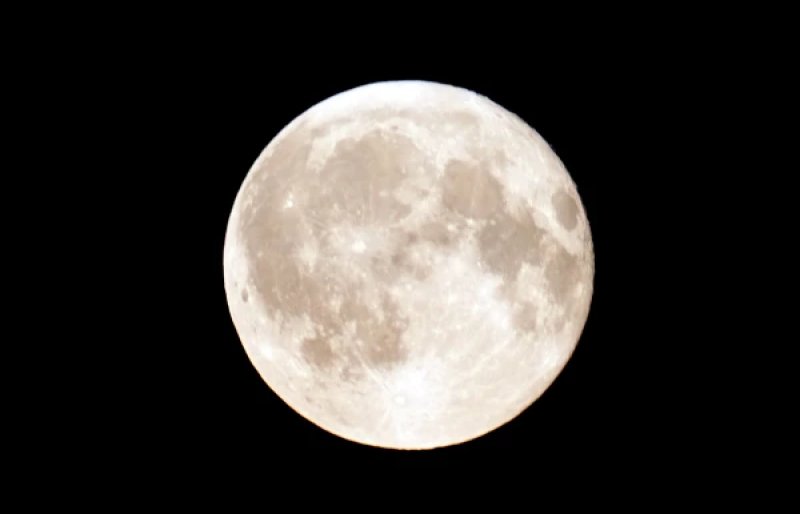
 Foto: BB.LV / Луна
Why does the Moon suddenly become "super"? It's quite simple. It orbits the Earth not in a perfect circle, but in a slightly elongated orbit. Therefore, sometimes it is closer to us, and sometimes further away. If the approach coincides with a full moon, it results in a supermoon. This time, the distance between the Earth and the Moon will be about 361 thousand kilometers. Compared to the farthest full moon, the lunar disk may appear about 14% larger and 30% brighter. But don’t expect a huge glowing sphere covering half the sky. The difference between a regular full moon and a supermoon is quite hard to notice with the naked eye. However, if you look at the Moon right after it rises, when it is low on the horizon, it may seem extraordinarily large. This is actually an optical illusion: our brain compares the Moon to trees and houses and exaggerates its size. The November full moon has a fun name — Beaver Moon. It comes from North America, where at this time of year, beavers prepare for winter, reinforcing their homes and gathering supplies. The full moon itself will occur on November 24 at 16:53 Latvian time. In Riga, the Moon will rise during the day, around 14:57, but it’s best to observe it after dark. There’s no need to rush: it will look almost full on both the 23rd and the 25th of November. No telescopes are needed for observation. Just look out the window or step outside if the sky isn’t covered with clouds. And if the November weather does spoil the view, the next opportunity will come on December 24. Then the Moon will come even closer to the Earth than in November.
