

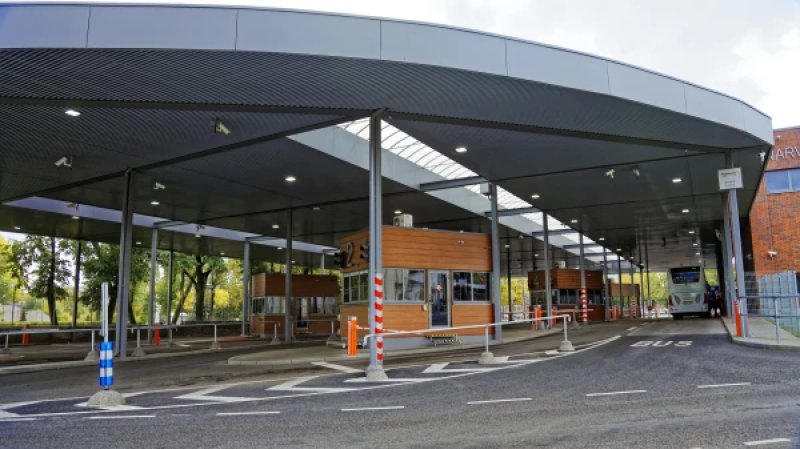
 Foto: BB.LV / КПП в Нарве
Estonia, a member of NATO and the European Union, announced on November 20 that starting December 1, it will completely suspend border crossings with Russia through all five road checkpoints. The restriction will affect not only vehicles but also pedestrians: in particular, it will no longer be possible to cross the border on foot in Narva, where such a crossing had previously been allowed. The measure will be in place for six months, after which the government will assess the security situation and decide whether to extend or revise the restrictions. ## ## Why is Estonia closing the border? The decision was made following an attempted arson at the premises of the Estonian drone manufacturer Threod Systems in Viimsi, north of Tallinn, on November 14. According to the Estonian Internal Security Service, the attempted attack was orchestrated by the Russian military intelligence - GRU. Eight Latvian citizens were detained, and the investigation suggests they were recruited to carry out the operation. Security personnel managed to intervene before significant damage was done. Estonian authorities described this incident as part of a broader series of sabotage and hostile activities against the country and other European states. The government stated that closing the border would complicate the work of Russian intelligence services in recruiting and influencing people, as well as help prevent circumvention of sanctions. Moscow rejected the accusations. Kremlin spokesman Dmitry Peskov called these claims unfounded, while Russian Foreign Ministry spokeswoman Maria Zakharova accused Estonia of violating the rights of Russian citizens and threatened political and diplomatic retaliation. Zakharova also compared the planned closure to the construction of a new iron curtain. ## ## Families Divided by the Border For residents of the border region, this decision goes beyond security concerns. Narva, an Estonian city with a population of over 50,000, a significant portion of whom are Russian-speaking, is located directly across from Ivangorod on the other side of the Narva River. The two cities have long been connected by family, social, and economic ties, with many residents having relatives on both sides of the border. This checkpoint was also popular among residents from other European countries traveling to St. Petersburg. Russia halted vehicle traffic through the Narva checkpoint in February 2024; however, pedestrians continued to cross the border. Narva Mayor Jaan Toots urged the Estonian government to provide humanitarian exceptions for residents who need to visit elderly relatives, attend funerals, or address other urgent family matters. He also warned of potential economic consequences for the city, including possible losses for local hotels, restaurants, and businesses. The border closure is expected to impact employment in the region, where local workers include border guards and customs officers. ## ## Border Crossings Have Already Decreased Sharply The number of people traveling between Estonia and Russia has already significantly decreased since the beginning of the full-scale Russian invasion of Ukraine. According to the Estonian public broadcaster ERR, the annual number of border crossings dropped from over four million in 2022 to about 760,000 in 2026. Of these, approximately 447,000 were at the Narva-Ivangorod checkpoint, according to figures provided by AFP. As reported by Reuters, Russian citizens made 307,000 crossings this year, Estonian citizens accounted for 175,000, and holders of Finnish passports crossed the border 54,000 times. The planned restrictions will apply to all five road checkpoints: Narva-1, Narva-2, Koidula, Luhamaa, and Saatse. Rail freight transport will continue with existing restrictions and customs controls. Travelers will have to use alternative routes through neighboring countries, primarily Latvia, with trips likely becoming longer and more expensive. Currently, the closure is planned for six months, rather than indefinitely. The Estonian government states that it will review the measure after this period depending on the security situation.
