

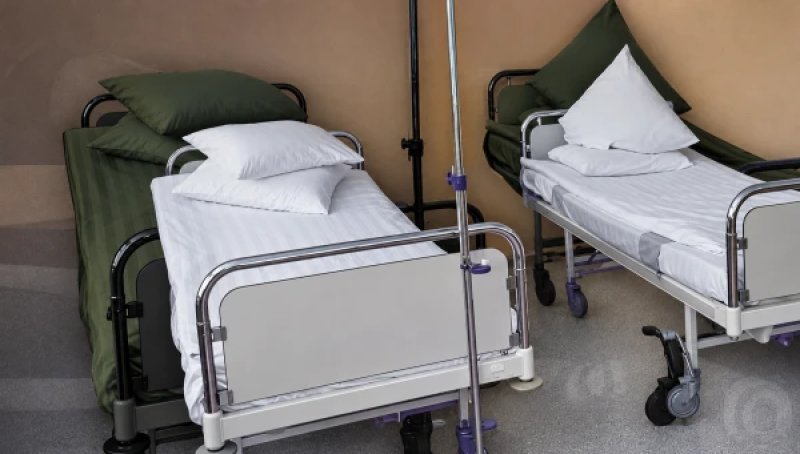
 Foto: BB.LV / Два аккуратно заправленных больничных места
As the program [TV3](https://tv3.lv/zinas/latvija/neka-personiga/vismaz-astoni-cilveki-pec-izrakstisanas-no-slimnicam-bezpalidzigi-palikusi-uz-ielas/) Nekā personīga found out, there have been tragic cases over the years. ### After a stroke — 50 kilometers to home without shoes and outerwear Zigfrīds and Girts Ozoliņš served for many years in the National Armed Forces and the National Guard. Now the couple is retired and lives in the vicinity of Nereta. In January, Girts suffered a stroke. He has been assigned a second group disability: the man moves with the help of a walker, and his hearing has also worsened. His wife provides daily care for him. A few weeks ago, due to severe pain in his leg, the couple called an ambulance. At night, the medics took Girts to the Jekabpils Regional Hospital, located about 50 kilometers from home. > "The ambulance took me in pajamas. I was in what I had on in bed at night — in pajamas, only my socks were on my feet," the man recalls. In the morning, Zigfrīda arrived at the hospital, bringing her husband a phone, but she was unable to see him. The medics promised to contact her if necessary, and the woman went home by bus. Later, it turned out that Girts was to be discharged. > "Then it turned out that I had these pants in my bag, but I didn't even have a jacket, and I was told to go home," the pensioner said. The hospital inquired if anyone could pick him up by car. But the family had no such opportunity. The man, who finds it difficult to move even with a walker, could not imagine how to cover dozens of kilometers in home slippers, without outerwear. According to him, the nurses allowed him to lie in a separate room until a solution could be found. ### They asked for 70 euros for the ride home A social worker from the hospital spoke with Girts, who informed him about the possibility of using a private transport service. The ride home would cost 70 euros — a sum that was too large for the pensioner. By the time Zigfrīda learned about her husband's discharge, the last bus to Jekabpils had already left. The situation was saved by a family acquaintance who agreed to come by car and take Girts home practically for free — the couple only had to pay for the fuel. > "This system definitely needs to change. Where has humanity gone? Humanity has disappeared," Zigfrīda says. Girts himself believes it is unfair that the ability to return home safely essentially depends on the availability of money. > "Not all of us are wealthy enough to just pull out money and not even take change," the pensioner noted. ### People have disappeared, and some have frozen to death Journalists from Nekā personīga established that the case of the Ozoliņš family is far from unique. In early November, after being discharged from the Center for Psychiatry and Addiction, a woman went missing and got lost. Last year, a similar case occurred with a patient suffering from dementia who was discharged from the Trauma and Orthopedics Hospital. Several years ago, a pregnant woman with a small child was left overnight near the Children's Clinical University Hospital, unable to get home to Sigulda. There are also tragic cases: according to the program, at least four people have frozen to death in different years after being discharged from medical institutions. Back in 2016, signatures began to be collected on the public initiative portal Manabalss.lv demanding to solve the problem. However, ten years later, a unified order for assisting such patients has not yet appeared. ### Hospitals do not know where their responsibility ends The chief physician of the Jekabpils Regional Hospital, Ilze Bikova, claims that the medical staff tries to take the patients' circumstances into account. According to her, at night, staff ask if a person can get home on their own. The hospital also has ten observation beds where a patient can be kept until morning if necessary. However, the head of the medical institution believes that without clear state regulation, the problem will remain unresolved. > "If we had clear regulations, we could act according to this legal act. But should the hospital always take on the functions of a social service and to what extent?" Bikova questions. Major hospitals hold a similar position: treatment falls under their responsibilities, while organizing transportation home is more in the realm of social services. At the same time, the scale of the problem is significant. Several dozen patients arrive at the Pauls Stradiņš Clinical University Hospital every week who need assistance getting home after treatment. Some are unable to move independently, and relatives refuse to pick them up. READ MORE >> [If trouble has come to the house: who will take care of a dying person in Riga](https://bb.lv/statja/nasha-latvija/2026/07/20/esli-v-dom-prisla-beda-kto-v-rige-pozabotitsia-ob-umiraiushhem-celoveke) ### Local governments help, but not in emergencies In some hospitals, social workers from local governments are involved in resolving such situations. However, municipal services usually operate on a set schedule and are not always available in the evenings and on weekends. Moreover, assistance with transportation often needs to be ordered in advance. For example, in the Aizkraukle region, where Girts lives, processing a relevant application can take up to ten days. Ilze Rudzīte, an advisor to the Latvian Association of Local Governments, believes that hospitals should better plan patient discharges. In particular, they should organize them during working hours whenever possible and notify social services in advance. According to her, problematic situations arise when a medical institution calls the local government on Friday at 4:30 PM and informs them that a patient needs to be urgently picked up. ### Ten years of discussions — and no common solution The State Secretary of the Ministry of Health, Agnese Valuļīne, acknowledges that the main obstacle remains the distribution of responsibility and funding. It is necessary to determine who should pay for the transportation of the patient home, and who should cover their temporary accommodation if leaving immediately is not possible. According to Valuļīne, the discussion should involve the Ministry of Health, local governments, and probably the Ministry of Welfare. READ MORE >> [Social centers in Latvia are unable to cope with the influx of elderly people – what to do?](https://bb.lv/statja/nasha-latvija/2026/05/16/socialnye-centry-latvii-nesposobny-spravitsia-s-potokom-pozilyx-liudei-cto-delat) So far, substantive negotiations have mainly been held with the Welfare Department of the Riga City Council. The capital was planned to be used as a pilot project, with the intention of then extending the found solution to other local governments. However, there are no concrete results yet. ### The new health minister has not heard of the problem The declaration of the new government of Andris Kulbergs includes a review of the functions of the health and welfare ministries to improve the interaction of medical and social services. However, the new Minister of Health, Normunds Staņevičs, admitted to journalists that he had not encountered this problem before. This is notable, as he previously headed the board of the Riga Eastern Clinical University Hospital for two years, as well as the temporary council of the Stradiņš Hospital. When asked by Nekā personīga whether the problem was discussed during his time in the hospitals, the minister answered negatively. > "I think this needs to be addressed. I believe that, first and foremost, I need to delve deeper into this issue myself," Staņevičs stated. The Minister of Welfare, Ilze Indrikson, also acknowledged the need for a systemic solution, including financial assistance for patients who cannot pay for their transportation home independently. ### Staying overnight in the hospital does not mean getting home One of the options being considered by the Ministry of Health is providing patients with temporary accommodation in the hospital or outside it. Some large medical institutions already offer such an opportunity. However, this only solves part of the problem. For a person with limited mobility, waiting in the morning does not replace special transportation. And if public transport does not go to their home, the lack of money for transportation remains an obstacle regardless of the time of discharge. The story of Girts Ozoliņš shows that even after receiving the necessary medical care, a patient can find themselves in a situation where returning home becomes a separate ordeal. While state institutions figure out who should be responsible for this, the solution often depends on the help of acquaintances, relatives, or the goodwill of hospital staff.
