

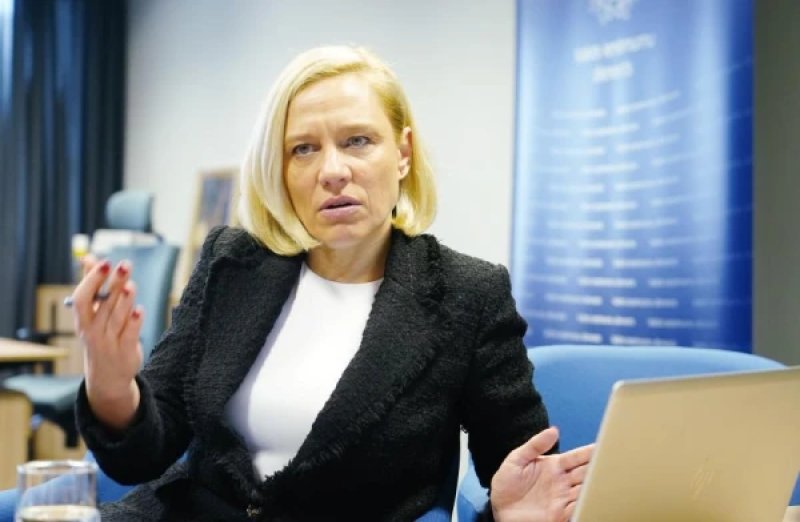
 Foto: BB.LV / Байба Шмите-Роке
The Director General of the SRS, Baiba Shmite-Roke, explained in an interview with [nra.lv](https://nra.lv/latvija/534335-baiba-smite-roke-skaidro-kapec-vid-vel-nevar-aizpildit-deklaracijas-iedzivotaju-vieta.htm) why Latvia cannot yet implement certain digital solutions that have already appeared in Estonia, and what role citizens' trust in the state plays in this. ### Why can’t the SRS do everything for the taxpayer? According to Baiba Shmite-Roke, entrepreneurs often ask why the SRS cannot independently prepare declarations using the information available to the state. The head of the service acknowledges that this would indeed simplify life for taxpayers. But there is a significant obstacle — the lack of necessary data. > "We would be happy to relieve you of the need to submit all declarations, but we need data for that," Shmite-Roke explained. In particular, the SRS does not have direct access to all transactions on residents' bank accounts. As the head of the service explained, the tax administration receives only one aggregated figure for the year, rather than detailed information about the flow of money. Therefore, the SRS's ability to automatically determine all income and expenses of an individual is limited. This does not mean that the service does not have any information about taxpayers' incomes at all. However, the available information is insufficient to completely eliminate the need for self-declaration in all cases. ### Estonia has gone further, but businesses are reluctant to share data As an example of deeper digitalization, Shmite-Roke cited Estonia. According to her, the neighboring country has consistently invested in digital government services for many years and is ahead of Latvia in certain areas. In October, Estonia launched a tool that allows the tax administration to obtain information directly from the accounting systems of enterprises. This approach potentially reduces the amount of reporting that entrepreneurs have to prepare and submit themselves. However, even in Estonia, the implementation of this innovation is not easy. According to Shmite-Roke, entrepreneurs are cautious about it, and so far only a few percent of companies are using the tool. This example, the head of the SRS believes, shows that technological capabilities alone are not enough. The willingness of businesses to provide the state with broader access to their data is equally important. ### Why is trust more important than technology? Shmite-Roke acknowledges that there is still a cautious attitude towards the tax administration in Latvia. For many residents, the expansion of the SRS's access to financial information may raise concerns, even if more convenient service is offered in return. Therefore, in the opinion of the head of the service, transitioning to a more automated declaration system cannot be achieved with a single solution. First, it is necessary to strengthen trust between taxpayers and the state. At the same time, the responsibility also lies with the SRS itself. Shmite-Roke admits that the service still needs to make communication with the public clearer. Currently, the agency is trying to use a friendlier tone in letters and explain regulatory requirements in simple language. However, as the head of the SRS acknowledges, this is not always successful: citizens still encounter responses that are difficult to understand. She urges residents to report such cases and not to be afraid to criticize the service. According to her, feedback helps identify shortcomings and improve service. ### What about the experience of Lithuania? The interview also discussed the experience of Lithuania, where tax administration employees travel to regions and help residents fill out declarations. However, Shmite-Roke does not believe that Latvia needs to adopt this practice right now. She explained that the SRS's services are already available in digital format. For those who do not use computers or have difficulties with electronic services, assistance is provided by customer service centers. In the opinion of the head of the service, further development should primarily be related to simplifying the procedures themselves, rather than just expanding the opportunities to receive consultations. ### Trust in the SRS has increased by 10 percentage points Despite existing problems, Shmite-Roke notes positive changes as well. She referred to a study by the State Chancellery, according to which from 2024 to 2025, the level of trust among residents in the SRS increased by 10 percentage points. For the leadership of the service, this indicates a gradual change in society's attitude towards the tax administration. However, there is still a long way to go before transitioning to a system where most declarations could be fully generated without taxpayer involvement. The main question is not only about creating the appropriate digital tools but also about what data residents and entrepreneurs are willing to trust the state. According to the head of the SRS, this largely determines how simple and automated tax reporting will become in the future.
