

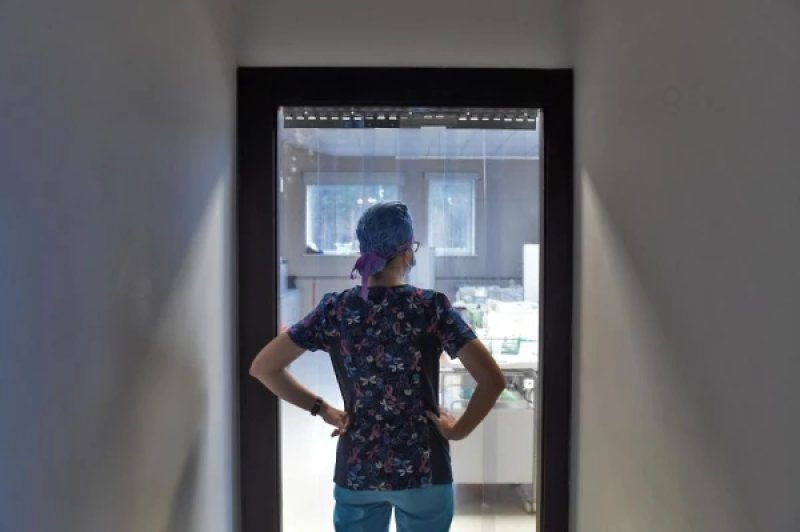
 Foto: BB.LV / медсестра смотрит в окно
A pregnant woman with a small child, a woman with dementia, a second-group disabled person — all of them find themselves on the street after being discharged from the hospital. The Ministry of Health has been unable to solve this problem for years, as the state has not determined who should be responsible for such patients — hospitals or local governments, reports the program Nekā Personīga. ## ## In Pajamas and Socks — 50 Kilometers from Home Zigfrīds and Girts Ozoliņš are veterans of the National Guard, having worked for many years in the National Armed Forces. After retiring, the couple lives in Girts' ancestral home in the vicinity of Nereta. They continue to actively participate in the defense of the country, working with the "Barricades of the Defenders of the Fatherland" society and developing a plan for non-violent resistance in case of invasion. In January of this year, Girts suffered a stroke. He was assigned a second-group disability and moves with the help of special walkers, and his hearing has worsened. After the illness, the man is recovering at home, cared for by his wife. However, a few weeks ago, he needed medical assistance. Due to severe leg pain that persisted for several days even after taking prescription medications, the couple called an ambulance. "The ambulance took me in my pajamas. I was taken just as I lay in bed at night, only I managed to put on socks. I was carried on a stretcher to the car, and we left," Girts recounts. At night, he was taken to the Jēkabpils Regional Hospital, located about 50 kilometers from home. In the morning, Zigfrīda arrived there, bringing her husband a phone. She was not allowed to visit him, but the doctors promised to call if anything happened. The woman took the bus home. Meanwhile, the hospital decided that they could not help Girts and discharged him. "Then it turned out that I had pants in my bag, not even a jacket. And I was told to go home. They asked if there was anyone who could pick me up by car. I realized that I would have to walk in these socks and home slippers. I need to get from the Jēkabpils hospital here, but how? The nurses, apparently, took pity on me and led me to a room where I could at least lie down while something was decided," the man recalls. A social worker told Girts about private transport services that could take him home for 70 euros. The pensioner could not afford such money. When Zigfrīda learned about her husband's discharge, the last bus to Jēkabpils had already left. In the end, a friend helped the couple, agreeing to bring Girts home for money for gas. "This system definitely needs to change. Where is humanity? Humanity has disappeared," says Zigfrīda. ## ## At Least Four People Have Died Girts' story is not unique. Regular reports emerge in the public space about people who end up on the street after being discharged from the hospital. In early November, a woman was discharged from the Center for Psychiatry and Narcology, who got lost and disappeared. Last year, a woman with dementia disappeared after being discharged from the Trauma and Orthopedics Hospital. A few years ago, a pregnant woman with a small child found herself on the street at night near the Children's Clinical University Hospital — she had no way to get home to Sigulda. There have been instances where discharged patients froze to death. There have been at least four such cases. Back in 2016, a petition was started on the public initiative portal Manabalss.lv to draw politicians' attention to the problem. However, a systemic solution is still lacking. The chief physician of the Jēkabpils Regional Hospital, Ilze Bikova, claims that patients are always asked at night if they can get home. The hospital also has ten observation beds where patients can stay until morning. "If we had clear regulations, we could act in accordance with the normative act. But should the hospital always take on the functions of a social service, and to what extent?" Bikova questions. ## ## Hospitals or Local Governments? Large hospitals believe that transporting patients home is not part of their responsibilities. This is a social function, and the state must determine who will perform it. In some hospitals, social workers from local governments are involved in addressing the problem. However, they only work during business hours and are unavailable on weekends. The Pauls Stradiņš Clinical University Hospital receives several dozen patients weekly who need help getting home. Some are unable to do so independently, while others have relatives who refuse to come. The problem has been known for at least ten years, yet its solution has stalled in working groups and searches for responsible parties. State Secretary of the Ministry of Health Agnese Valūlene explains that it is necessary to agree on the distribution of responsibility and sources of funding — who will pay for the patient's transportation home or their stay in the hospital for another night. Concrete negotiations have only been held with the Welfare Department of the Riga City Council. A working group was created to discuss the integration of medical and social services, including the transportation of helpless patients home. However, no solutions have been found. Riga was supposed to be a pilot project, after which the problem would be addressed in other municipalities. The Latvian Association of Local Governments notes that municipalities are already offering transportation services for patients to and from hospitals. However, transport must be ordered in advance, making such a service useless in emergency situations. In the Aizkraukle region, where Girts lives, processing an application can take up to ten days. Ilze Rudzīte, advisor to the Latvian Association of Local Governments on health and social protection issues, believes that hospitals need to plan patient discharges. "Not like this, where a medical institution calls on Friday evening at 4:30 PM and says: 'Come pick up your resident.'" ## ## The New Minister Has Not Even Heard of the Problem The declaration of the new government of Andris Kulbergs includes a point about reviewing the functions of the health and welfare ministries to improve interaction between medical and social assistance. However, for the new Minister of Health Normunds Staņēvičs, a problem that has been discussed for many years came as a surprise. He had previously headed the board of the Riga Eastern Clinical University Hospital for two years and was also the chairman of the temporary council of the Pauls Stradiņš Hospital. — When you worked at the hospital, did this issue not come up? — No. — Did no one talk about it at all? — I had not heard of such a thing, — the minister admitted in a conversation with Nekā Personīga. Minister of Welfare Ilze Indrikson (National Alliance) believes that the problem needs to be solved both organizationally and financially, ensuring assistance to those who cannot afford to pay for transport. "Not all of us are wealthy. It turns out that only wealthy people can fully utilize such a service, while those without money cannot go at all. It seems I should have refused the ambulance service," says Girts Ozoliņš. The Ministry of Health reports that one of the discussed options is to provide patients with accommodation — in the hospital or outside of it. Large hospitals claim that they already provide such an opportunity. However, waiting until morning does not help those who physically struggle to move and whose homes are not served by public transport.
