

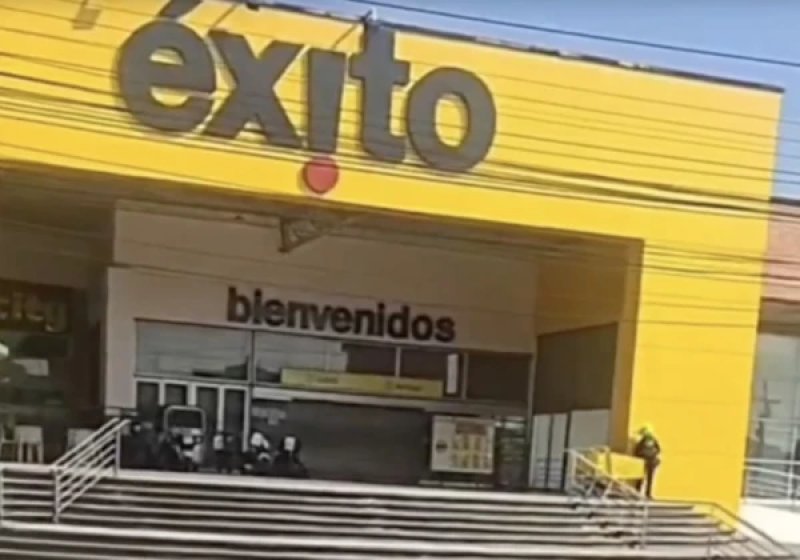
 Foto: BB.LV / exito
In the Colombian city of Cartagena, armed men took dozens of hostages in an Éxito supermarket. Police, military, and special units surrounded the building, trying to secure the release of the people. The drama unfolded on Tuesday, November 24, in the La Castellana neighborhood. According to local authorities, the initial target of the criminals was an armored vehicle transporting money. However, the robbery attempt failed. After police intervention, the attackers took refuge in a nearby supermarket, where they held customers and store employees hostage. Preliminary reports indicate that about 30 people were taken hostage. ### Ten Hostages Successfully Released For several hours, police conducted an operation to free the hostages. The area around the supermarket was cordoned off, armed units arrived at the scene, and snipers were positioned on nearby buildings. Power supply was also temporarily cut off in the area. During negotiations, the criminals released ten people, including five elderly women. According to information published by Reuters, after this, at least 20 hostages remained inside the supermarket. Among those held were both customers and store employees. Authorities stated that the priority of the operation was to preserve the lives of the hostages and secure their safe release. ### Criminals Demanded Money and an Escape Route According to Colombian media reports, the captors made several demands. In particular, they allegedly requested about two million dollars, two armored vehicles, and safe passage to the city of Barranquilla, located about 130 kilometers from Cartagena. There was no official confirmation of all these conditions at the time of the initial reports. Local journalists indicated that negotiators were working with the armed men, trying to convince them to release the remaining people without using force. ### President of Colombia Arrives at the Scene The situation gained national significance after Colombian President Abelardo de la Espriella altered his work schedule and traveled to Cartagena. He arrived in the city with representatives of the security forces to personally participate in coordinating the authorities' actions. The president emphasized that, according to preliminary information, the hostage-taking was not linked to the activities of terrorist organizations or rebel groups. He stated that it involved ordinary criminals who found themselves in a dead-end situation after a failed robbery attempt. "The hostages will be fine. I’m not sure the same will be true for the criminals," de la Espriella stated. The head of state highlighted that the armed men initially planned to steal money, but after the robbery failed, they attempted to use people as hostages. ### Why Did the Incident Cause Particular Concern? Cartagena is located on the Caribbean coast and is one of Colombia's main tourist centers. The city is known for its historic center with colonial architecture, beaches, and cruise tourism. The hostage-taking in a busy shopping area caused significant resonance, as such incidents pose a threat not only to local residents but also to visitors to the city. Additionally, the operation of the security forces temporarily affected the transportation infrastructure. According to Reuters, Cartagena's airport briefly restricted the landing of planes due to the actions of the security forces' aviation. ### An Explosion Occurred in Another City the Day Before The hostage-taking occurred against the backdrop of escalating security issues in Colombia. On the evening of Monday, November 23, a car bomb exploded in the city of Villavicencio. Twenty-five people were injured, and significant damage was caused to buildings and other infrastructure. The explosion occurred on the eve of the tenth anniversary of the peace agreement signed in 2016 between the Colombian government and the leftist group Revolutionary Armed Forces of Colombia (FARC). Although the agreement allowed for the end of a long-standing conflict with the main structure of FARC, some former members of the group continued armed activities. Authorities believe that the explosion in Villavicencio may have been carried out by representatives of one of these dissident groups. Local media reports mention a former FARC commander known as Antonio Medina. However, there is no proven connection between the explosion in Villavicencio and the hostage-taking in Cartagena. Colombian authorities view the incident in the supermarket primarily as a failed robbery that escalated into a hostage situation. According to the latest confirmed reports, law enforcement agencies continued to work towards the release of the remaining hostages in the supermarket. The final results of the operation were not known at the time of publication of this information.
