

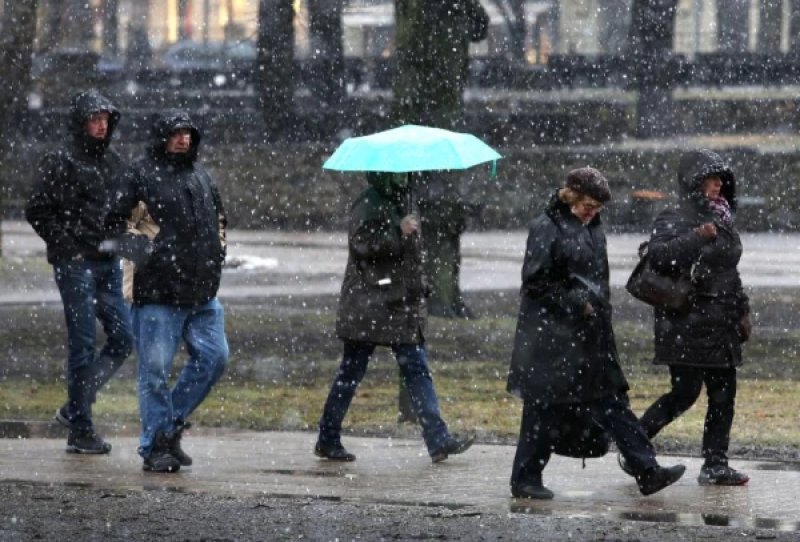
 Foto: BB.LV / люди под снегом
The last week of November will bring true winter weather to Latvia. According to meteorologists' forecasts, air temperatures will continue to drop in the coming days, and by the end of the week, frosts are expected in all regions of the country. In some areas, meteorological winter has already begun, according to preliminary data. For example, at the meteorological station in Alūksne, the average daily temperature has remained below zero since Monday, November 23. Overall, the start of meteorological winter in Latvia is forecasted for the period from November 25 to 27. ### What is meteorological winter and when does it begin? Unlike calendar winter, which begins on December 1, meteorological winter is defined not by a date but by actual weather conditions. In Latvia, it begins when the average daily temperature remains below zero for at least five consecutive days. When this condition is met, the first day of the five-day period is considered the start of winter. Therefore, the date of the onset of meteorological winter can only be definitively confirmed after the negative average daily temperature has persisted for the required number of days. In recent years, winter has arrived in Latvia at different times: - 2025 — November 23; - 2024 — December 4; - 2023 — November 17; - 2022 — November 17. Thus, the current cooling corresponds to the usual timing of the winter season's onset, although it does not begin simultaneously in different regions of the country. ### When will frosts hit −10 degrees? On Thursday, November 26, light precipitation — rain and snow — is still expected in some parts of Latvia. However, the weather will then become predominantly dry. There will be fewer clouds, and nighttime cooling will intensify. Starting from Friday, November 27, negative temperatures are expected across the country. In the coldest nights, thermometers in some places may approach −10 degrees. At the same time, light frosts will persist during the day over most of Latvia. The cooling will be associated with the strengthening of an anticyclone — an area of high atmospheric pressure that usually brings calmer weather, light winds, and little precipitation. On Saturday, November 28, the center of the anticyclone will be directly over Latvia. With clear skies and light winds, the ground loses heat more quickly at night, so temperatures can drop significantly below zero even without heavy snowfall. READ MORE >> [Frosts down to −10 degrees are coming to Latvia: meteorologists warned of a sharp change in weather](https://bb.lv/statja/nasha-latvija/2026/11/23/v-latviiu-idut-morozy-do-10-gradusov-sinoptiki-predupredili-o-rezkoi-peremene-pogody) ### Thaw up to +8 degrees possible next week Despite the expected frosts, winter weather may prove unstable. After Saturday, the center of the anticyclone will gradually shift southeast. Winds from the south and southwest will slightly strengthen in Latvia. According to preliminary forecasts, there will be little precipitation next week, but temperature calculations still vary significantly. The highest likelihood of warming remains in Kurzeme, where temperatures may rise to +8 degrees. In Latgale, colder weather is expected at the same time. This difference between regions means that winter frosts in the western part of the country may give way to thaw, while in the east, negative temperatures will persist longer. At the same time, the forecast for next week may still change, so it is too early to talk about stable warming. ### What does the cooling mean for residents? At negative temperatures, even a small amount of moisture on roads and sidewalks can freeze, creating slippery spots. Extra caution should be exercised in the morning and evening, as well as on roads where wet surfaces remain after daytime warming. If a thaw indeed begins next week in the western regions, temperature fluctuations around zero may again contribute to the formation of ice. Thus, the coming days will bring Latvia its first longer-lasting frosts of the current winter season. However, the onset of meteorological winter does not mean that there will be no more thaws: already in early December, the weather in different parts of the country may vary significantly.
