

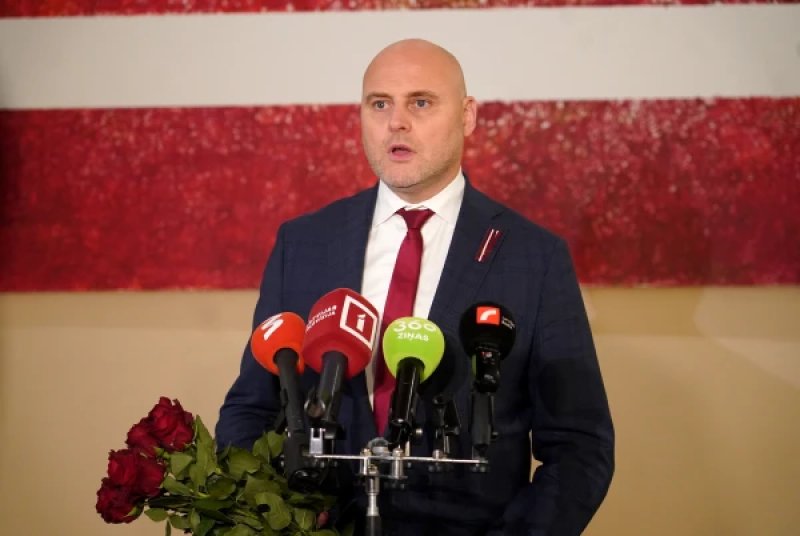
 Foto: BB.LV / Андрис Кулбергс
The Latvian government may have three deputy prime ministers, each responsible for a specific area of state reforms. Andris Kulbergs ("United List") announced this on Wednesday, November 25, in an interview with TV3. According to the prime minister, there are three areas that need special attention and for which specific responsible leaders should be appointed. These include state digital security, the review of government functions, and the implementation of large projects. ### What Will the New Deputy Prime Ministers Do? Kulbergs highlighted three areas of future work: - Information and communication technologies and cybersecurity. This area includes issues related to the development of state IT systems and the protection of digital infrastructure. - Review of state functions and artificial intelligence. The task is to assess the performance of the government apparatus, eliminate duplicate functions, and explore opportunities for using AI. - Management of large projects. A separate leader will need to coordinate the implementation of large state initiatives. The prime minister envisions that this structure will concentrate responsibility for the most important areas of government work with specific individuals. However, the appointment of deputies has not yet been finalized. Kulbergs will need to discuss the proposal with the second partner in the ruling coalition — the National Alliance. ### Will New Bureaus Be Created and Will Expenses Increase? The prime minister promises that no separate administrative apparatus will be created for the three deputies. According to him, this is solely about appointing three specific individuals, whose organizational support will be provided by the State Chancellery. Thus, Kulbergs hopes to strengthen the management of specific areas without creating new bureaucratic structures. However, the absence of separate bureaus does not in itself mean that the appointment of deputies will not require additional expenses. In particular, the prime minister has not yet clarified the future status of these positions, the conditions of remuneration, and the specific mechanism for distributing powers between them and the current ministers. READ MORE >> [Newcomers, Non-partisans, and Vice Prime Ministers in Reserve: How the New Government of Latvia Was Chosen](https://bb.lv/statja/politika/2026/11/20/novicki-bespartiinye-i-vice-premery-v-zapase-kak-vybirali-novoe-pravitelstvo-latvii) ### Who Could Take the New Positions? The idea of appointing deputy prime ministers was discussed during the formation of the new Cabinet of Ministers. Initially, there were two possible candidates — the parliamentary secretary to the prime minister, Krista Avotsa, and the chairman of the board of the telecommunications company Tet, Uldis Tatarcuks. It was previously reported that Avotsa could be responsible for information technology and the digitalization of government. Tatarcuks was considered as a potential head of the cybersecurity direction, but later information emerged about his potential appointment as responsible for large state projects. Now Kulbergs speaks of three separate areas, but has not yet named all potential deputies or clarified the final distribution of responsibilities. Therefore, previous assumptions about the appointment of Avotsa and Tatarcuks should not yet be regarded as finalized personnel decisions. ### The Prime Minister Will Personally Oversee the Liquidation of the Ministry of Climate and Energy At the same time, the government is preparing changes to the structure of ministries. Kulbergs stated that he will personally oversee the liquidation of the Ministry of Climate and Energy. It was previously reported that the functions of the ministry are to be redistributed between the Ministry of Economics and the Ministry of Smart Governance and Regional Development. The government's plan is that the reorganization should contribute to reducing the government apparatus and increasing management efficiency. However, the prime minister has not yet been able to specify the exact amount of savings from closing the ministry. When asked about the financial outcome of the reform, Kulbergs replied that a separate meeting on this matter would take place on Wednesday. READ MORE >> [Kulbergs Will Reduce the Number of Ministries and Allow Non-partisan Ministers: What Is Known About the New Government](https://bb.lv/statja/politika/2026/11/16/kulbergs-sokratit-cislo-ministerstv-i-dopustit-bespartiinyx-ministrov-cto-izvestno-o-novom-pravitelstve) ### Will Government Management Become More Efficient? The creation of new leadership positions occurs against the backdrop of government promises to reduce bureaucracy and state expenses. In this context, the key question remains not so much the number of deputy prime ministers as their real powers and work results. The appointment of those responsible for digitalization, artificial intelligence, and large projects may improve coordination between ministries. However, the effectiveness of such a model will depend on whether the new leaders can make decisions and resolve the issues that currently arise in the interaction between ministries. At the same time, the liquidation of the Ministry of Climate and Energy does not guarantee automatic savings: some functions, employees, and expenses will need to be transferred to other institutions. Thus, the government still needs to explain what the financial outcome of the planned changes will be and how the creation of three new leadership positions aligns with the promise to reduce administrative expenses.
