

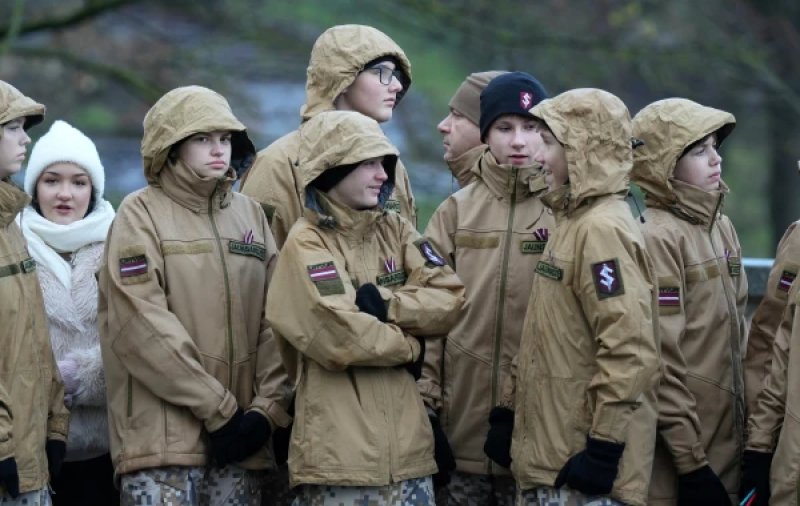
 Foto: BB.LV / jaunsardze
Schoolchildren in Latvia are eager to learn shooting, orienteering, and other practical skills; however, the theoretical part of state defense lessons does not always spark the same interest. These conclusions were reached by journalists from Latvijas Avīze and regional publications, who studied how the mandatory subject is taught in Latvian schools in November. During the preparation of the material, journalists spoke with students, teachers, and instructors to find out what young people like, what difficulties arise, and how successfully the new course has been implemented. ### 36,000 Students and 320 Instructors Today, about 36,000 young people in 271 educational institutions in Latvia study state defense. Approximately 320 instructors conduct the classes. The subject began to be implemented back in 2018, when schools were given the opportunity to voluntarily include it in the curriculum. Starting from September 2024, the course became mandatory for students in the 10th and 11th grades of general secondary schools, as well as corresponding courses in vocational educational institutions for full-time students. The main goal of the program is to provide young people with initial knowledge about state defense, teach them how to act in crisis situations, and introduce them to basic military skills. As explained by the Deputy Director of the Training and Education Center of the Youth Guard, Uldis Zupa, the defense lessons were initially viewed as a way to prepare young people during a time when there was no mandatory military service in Latvia. Subsequently, the need for such training became even more evident against the backdrop of deteriorating security in the region. ### Students Want to Shoot, Run, and Navigate The practical part of the classes generates the greatest interest among teenagers. Young people enjoy learning to handle training weapons, navigate using a compass, move through terrain, and complete outdoor tasks. However, lectures and presentations are not perceived as engaging. Some students admit that they find it difficult to maintain attention during theoretical classes. Nevertheless, there are no plans to completely replace theory with practice. Rudolf Kalvans, the director of the Department of General Education at the Ministry of Education and Science, notes that the subject includes not only the acquisition of physical and military skills. An important part of the program remains familiarization with the history of Latvia, the struggle for independence, the activities of military leaders, and issues of civic responsibility. According to Kalvans, young people would certainly prefer to run, shoot, jump, navigate using a compass, and hide rather than listen to stories about freedom fighters, colonels, and generals. However, the content of the course will not be limited to what students enjoy the most. ### One Day a Month or Classes Between Lessons Two main models of organizing state defense education are used in schools. Most often, one full school day per month is allocated for this subject. Other educational institutions distribute classes according to the regular schedule, alternating them with other subjects. At the same time, schools must adhere to established limits on academic load: a maximum of 36 academic hours per week. Because of this, school administrations have to find ways to include defense training in the schedule without overloading students. As Kalvans admits, some schools face challenges with suitable facilities, practical training areas, and the distribution of academic time. Nevertheless, the Ministry of Education believes that, overall, the implementation of the mandatory course has been successful. According to a representative of the ministry, there are no fundamental disagreements regarding the necessity of the subject, and the problems that arise are mainly related to the organization of education. ### There Could Be More Practical Classes Rudolf Kalvans believes that the established number of academic hours is sufficient from the perspective of the Ministry of Education. However, his personal opinion differs somewhat. Being a member of the National Guard as well, he believes that the academic load for state defense should be increased, primarily through practical training. In his opinion, students need more opportunities to apply the knowledge gained directly in the field. Thus, one of the main tasks for the further development of the course is to find a balance between theoretical content and practical skills that young people can use in real situations. READ MORE >> [Changes Coming This Fall: What Will Change for Residents of Latvia Starting September 1](https://bb.lv/statja/nasha-latvija/2024/09/01/peremeny-prihodyat-osenyu-chto-izmenitsya-dlya-zhiteley-latvii-s-1-sentyabrya) ### Defense Lessons Have Also Become Mandatory for Distance Learning Starting September 1, 2026, mandatory state defense has also been included in the programs for part-time and distance secondary education. Previously, students in such programs did not have equal opportunities to master this subject. Now a mixed format of education is provided: theoretical topics are studied remotely, while practical skills must be learned in person. According to the program of the Youth Guard Center, the course includes 56 hours of distance learning and 38 hours of in-person training. For students in distance programs, the practical block is scheduled for the second year of study. It is organized in the format of five consecutive days of in-person classes. During this training, students must acquire skills that cannot be fully obtained through a computer screen, including navigation, basics of drill training, and training shooting. The program also includes topics on civil protection, first aid, and actions in crisis situations. ### Why Do Schoolchildren Need Defense Training? Despite the name of the subject, its purpose is not limited to preparing future military personnel. The knowledge gained can also be useful in everyday life — for example, during emergencies, disruptions in infrastructure, or the need to assist another person. Training in navigation, safety basics, and actions in stressful situations is aimed at enhancing young people's readiness for various crises. At the same time, state defense lessons should not be confused with state military service: the school course is part of the educational program, not military service. The experience of the first years of mandatory education shows that there is interest among young people in practical classes. Now, the organizers face the task of making the theoretical part just as substantial and useful while maintaining the full scope of knowledge provided by the program.
