

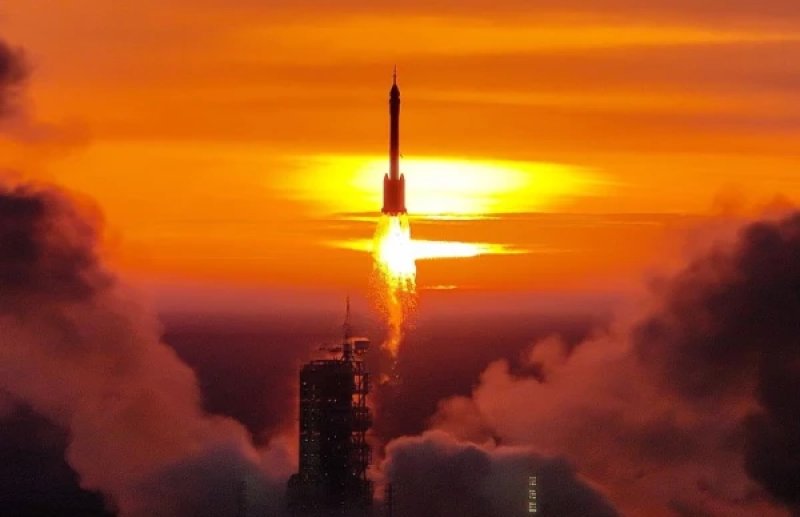
 Foto: BB.LV / запуск ракеты
China has taken an important step in the development of its manned space program by including a foreign astronaut in the crew of the spacecraft heading to the Tiangong orbital station ("Heavenly Palace"). On Wednesday, November 25, the Long March 2F rocket carrying the Shenzhou-24 manned spacecraft launched from the Jiuquan launch site in the Gobi Desert. The launch took place at 8:18 Beijing time, or 2:18 Latvian time. About ten minutes later, the spacecraft successfully separated from the rocket and entered the designated orbit, reported the China Manned Space Agency. ### Who Went to Space? On board Shenzhou-24 are three people: - Tang Hongbo — crew commander, experienced Chinese astronaut; - Wu Yi — flight engineer; - Muhammad Zishan Ali — a 40-year-old military pilot from Pakistan, payload specialist. For Ali, this flight is historic: he is the first citizen of Pakistan to go into orbit and the first foreign participant in a Chinese manned space mission. Previously, only Chinese astronauts had worked on the Tiangong station. The flight is the result of cooperation between the two countries in the space sector. In February 2025, China and Pakistan signed an agreement to prepare Pakistani candidates for manned missions. For Beijing, the inclusion of a foreign participant also signifies a shift towards broader international use of its own orbital station. ### Why Did the Pakistani Astronaut Go to Tiangong for Only Five Days? Unlike their Chinese colleagues, who will have a long-term assignment on the station, Muhammad Zishan Ali is on a short-term expedition. He is expected to spend about five days in orbit before returning to Earth on the Shenzhou-23 spacecraft along with part of the previous crew of the station. Despite the short duration of the flight, Ali's program includes several scientific experiments. One of them focuses on growing photosynthetic microorganisms in microgravity. Scientists are exploring the possibility of using such organisms in future life support systems for space stations and spacecraft. The idea is that they can utilize carbon dioxide and release oxygen, and some species could potentially serve as a source of nutrients. Such technologies are particularly important for future long-duration expeditions when regular supply deliveries from Earth will be challenging. Another study examines the effects of spaceflight on quinoa seeds — a plant considered a promising agricultural crop for cultivation in challenging conditions. Such experiments help scientists better understand how microgravity and the space environment affect living organisms. ### Who Is Currently on the Chinese Station? Before the launch of the new spacecraft, the crew of the Shenzhou-23 mission was working on Tiangong: - Zhu Yangzhu; - Zhang Zhiyuan; - Li Jiaxin. Li Jiaxin became the first female astronaut from Hong Kong to go to the Chinese orbital station. After the arrival of the new spacecraft, part of the previous crew will complete their expedition. Along with the Pakistani astronaut, Zhang Zhiyuan and Li Jiaxin are expected to return to Earth. However, Zhu Yangzhu will remain in orbit — he is set to undertake an even longer mission. ### China Prepares for Its First Year-Long Flight Zhu Yangzhu is expected to spend a total of about 12 months in orbit. If the program is completed, this will mark the first year-long stay of an astronaut in space in the history of Chinese manned spaceflight. Such expeditions are necessary to study how prolonged microgravity affects the human body. During extended flights, astronauts may experience changes in muscle and bone tissue, fluid redistribution in the body, and other physiological processes. It is also important for scientists to understand how prolonged isolation and working in confined spaces affect the crew's condition. The data obtained could be useful in preparing for future flights to the Moon and more distant objects in the solar system. ### Why Does China Need Its Own Space Station? Tiangong is a permanently operating Chinese orbital station designed for scientific research and long-term crew stays. China has built it independently and uses it for experiments in biology, medicine, materials science, and space technologies. Typically, three astronauts work on the station, and during crew changes, the number of people on board temporarily increases. However, Tiangong is not part of the International Space Station (ISS): it is an independent orbital complex. The admission of the Pakistani astronaut demonstrates that China is beginning to expand international participation in its manned program. READ MORE >> [In 2026, China Will Launch a Reusable Spacecraft](https://bb.lv/statja/tehno/2025/11/04/v-2026-m-kitai-zapustit-mnogorazovyi-kosmiceskii-korabl) ### The Next Goal — The Moon China plans to send its astronauts to the surface of the Moon by 2030. New manned spacecraft, launch vehicles, and landing modules are being developed for this purpose. Experience gained from working on Tiangong, including long-term expeditions and experiments with life support systems, helps refine technologies for future flights. The current mission is important for two reasons: it opens the Chinese station to a foreign astronaut for the first time and continues preparations for longer human stays beyond Earth. If the plans are fulfilled, China will gain new data on the feasibility of a year-long human presence in space, while Pakistan will gain its first experience of having its representative participate in an orbital expedition.
