

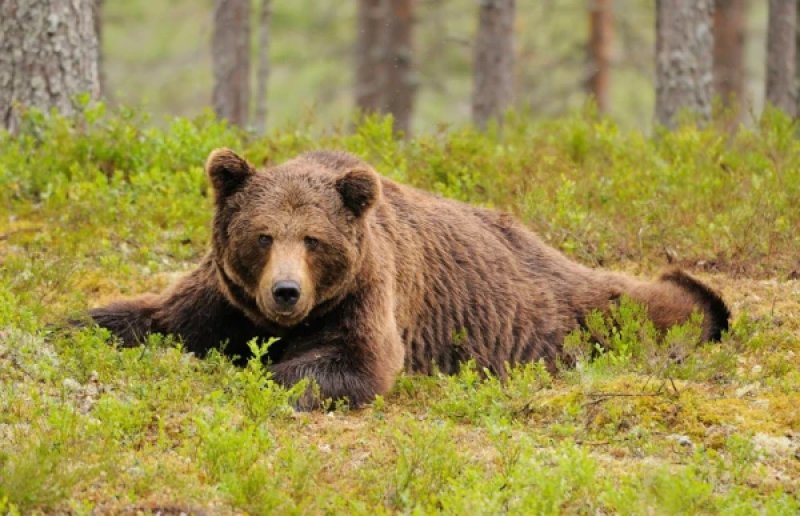
 Foto: BB.LV / Медведь
The number of bears in Latvia is increasing: a debate has erupted in the Saeima about whether they can be shot. The initiative has sparked sharp disagreements among Saeima deputies: some demand that human safety be prioritized over the protection of predators, while others believe that the problem should be addressed without mass shooting. As reported by the LETA agency, on November 25, the issue was discussed at a meeting of the Saeima's committee on mandates, ethics, and statements. ### Bears are increasingly appearing near homes The discussion was prompted by a civic initiative, the authors of which call for a review of the current rules for the protection of brown bears. According to the initiators, the population of these animals in Latvia has reached a level where encounters with them are no longer rare. Bears are spotted not only in forests but also near remote farms, homesteads, and settlements. The authors of the proposal believe it is necessary to allow preventive measures for protection, without waiting for a situation where serious harm has already been inflicted on a person. Currently, the brown bear is under strict protection, and its destruction is only permitted in the presence of an immediate threat to human health or life. Deputy of the ruling coalition Girts Lapins (National Alliance) stated that human life and safety should take precedence over the interests of bears. ### Out of 190 bears, only three are considered dangerous However, not all deputies agreed on the necessity to limit the population through shooting. Representatives of another position suggested focusing on preventing conflicts between humans and animals. In particular, the discussion centered on protecting farms, apiaries, and places where food waste is stored, which attract bears to human habitation. Deputy Atis Shvinka (Progressives) pointed out that, according to the data presented at the meeting, only three bears are currently recognized as dangerous. At the same time, the overall population of brown bears in Latvia is estimated to be around 190 individuals. In Shvinka's opinion, decisions affecting the entire population should not be made due to three problematic animals. He also noted that the issue of bear protection is regulated by European Union legislation, so any relevant changes need to be considered at the European level. At the same time, the deputy acknowledged that the growing population creates certain problems that require solutions. One of these he named is the protection of hunters involved in the removal of dangerous animals. ### Permits for shooting exist, but hunters fear the consequences The director of the Nature Conservation Department of the Nature Conservation Agency (DAP), Gita Strode, informed the deputies that current legislation already allows for the destruction of bears recognized as dangerous. In 2026, the agency issued five permits for the elimination of such animals. Moreover, three permits concerned the same bear, which moved across the territory of three regions of Vidzeme. However, having permits does not mean that the animals can be successfully removed. According to Strode, the main problem is that it is difficult to find hunters willing to carry out this task. They fear the consequences that may arise after shooting a bear. In particular, opponents of such actions may demand the revocation of hunting permits, subject hunters to public condemnation on social media, and exert other pressures on them. Strode suggested that the state should consider additional protective measures for hunters who carry out official decisions on the removal of dangerous animals. ### Compensation for damage caused by bears amounted to 13,000 euros A representative of the DAP also spoke about the material damage that bears have caused to Latvian farms. This year, the state paid about 13,000 euros in compensation. In one case, the compensation was related to a bear attack on cattle. Another nine claims were received from apiary owners affected by bears. In five cases, compensation was paid, while in the others, the applicants were denied. The reasons for refusals were the absence of registered bee colonies or insufficient damage that did not reach the established threshold for compensation. At the same time, Gita Strode emphasized that not every bear and not every appearance of one near humans poses a danger. ### The Saeima will continue the discussion Following the meeting, the committee on mandates, ethics, and statements supported the transfer of the civic initiative to limit the bear population to the Saeima's committee on economics, agriculture, environmental, and regional policy. It is expected that the parliament will be able to decide on the transfer of the initiative for further consideration in about a week. Thus, a decision on easing bear protection or expanding the possibilities for their shooting has not yet been made. ### When a bear is truly dangerous The Nature Conservation Agency reminds that brown bears usually do not show aggression and try to avoid encounters with humans. However, there are situations in which the animal can become dangerous. In particular, the risk increases if a bear is unexpectedly disturbed, especially during hibernation, if it is injured, or if it has no way to retreat. Particular caution should be exercised when encountering a mother bear with cubs. According to Strode, often the greatest danger comes not from the animal itself but from the incorrect behavior of people. When encountering a bear, specialists recommend staying calm, not approaching it, and not creating additional stressful situations. One should not chase the animal in a car, honk loudly, set dogs on it, run after the bear, or block its escape route. Any sighting of a bear, especially near populated areas, should be reported to the responsible authorities. ### The largest predator in Latvia The brown bear is the largest predatory animal inhabiting Latvia. Adult females can weigh up to 150 kilograms, while males can weigh up to 300 kilograms. The lifespan of a bear can exceed 30 years. Adult animals have virtually no natural enemies. Bears typically prefer large forested areas, especially old coniferous and mixed forests located near swamps, water bodies, overgrown clearings, and burnt areas. For hibernation, they choose natural shelters, predominantly in dry places near water. It is estimated that there are about 200,000 brown bears worldwide. The largest populations are found in Russia, the USA, Canada, and Romania. In many European countries, these animals previously disappeared, but in recent decades they have gradually returned to their former territories. In Latvia, the restoration of the population has now posed a question for the authorities on how to reconcile the protection of this rare predator with the safety of residents and the protection of agriculture.
