

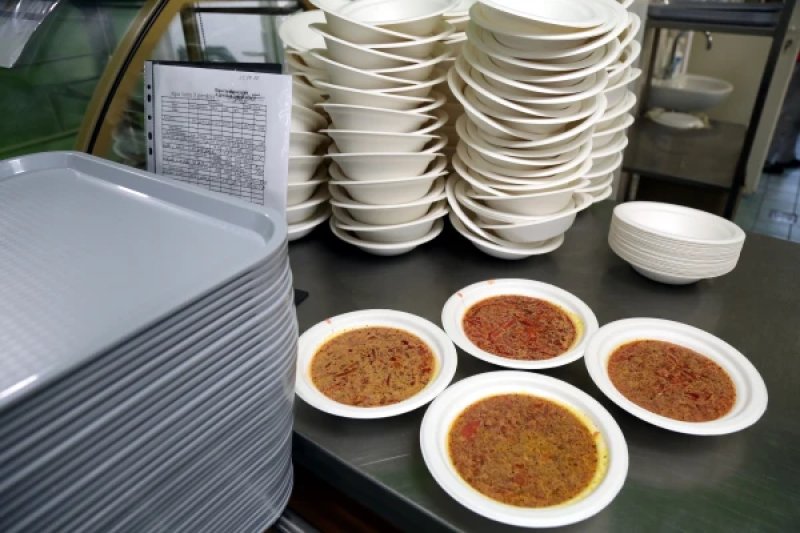
 Foto: BB.LV / суп в тарелках
Latvian farmers are ready to supply more vegetables, fruits, and other products to schools and kindergartens; however, the existing procurement system does not always allow local products to reach children's tables. Educational institutions in the country receive about 23,500 tons of food annually. A significant portion of these products is grown or produced in Latvia, but the share of local products is desired to be increased, writes LETA. According to Latvian Television (LTV), representatives of the agricultural sector are calling on the government to change procurement rules, while catering companies point out the practical difficulties of regularly supplying schools. ### In Sigulda, Parents Achieved Changes in the School Menu One example of more active use of local products is the Sigulda region. Here, parents of schoolchildren advocated for an increase in the share of organic vegetables in children's diets. According to the mother of one of the students, Liāne Klišāne, it was important for families that at least some products came directly from local organic farms. > "We considered it very important that at least some of the vegetables came from organic farms. This is something we can provide here in the region," she said. As a result of changes in the organization of food supply, the share of organic vegetables in school kitchens reached 30%. This experience shows that requirements for the composition of products in procurement can significantly influence school menus. However, extending such practices to all educational institutions is much more challenging. ### Why Can't Children Be Fed Only Latvian Products? Most schools in the Sigulda region are served by one catering supplier. Meat, dairy products, and a significant portion of vegetables come from Latvia. However, it is not yet possible to completely abandon imported products. The head of the procurement department at Aniva, Harijs Kalniņš, explains that suppliers need to consider three main factors simultaneously: the cost of products, their quality, and constant availability. One obstacle is the lack of logistics for small farms. A farmer may grow quality vegetables but may not have the capability to deliver them regularly and in the necessary quantities to several educational institutions at once. Another problem is dependence on the harvest. For example, in certain years, a poor harvest of carrots or another crop can significantly reduce the supply of local products. Meanwhile, school canteens must provide meals daily, regardless of weather conditions and agricultural season results. ### Farmers Are Confident: The Main Thing Is Guaranteed Demand From a different perspective, agricultural producers view the problem. The chairman of the board of the cooperative Ekoloģisks.lv, Raitis Rodinš, believes that farmers can provide the necessary products if they know the order volumes in advance. > "The most important thing is demand. If there is demand, we can grow, produce, supply, and sell," he emphasized. For agricultural enterprises, long-term agreements are especially important, as production needs to be planned in advance. If a farmer knows how many vegetables schools will need in the next season, he can organize sowing, storage, and deliveries accordingly. However, without predictable demand, expanding production carries the risk of being left with unsold crops. READ MORE >> [What Will Schoolchildren Eat in the New Academic Year? There May Be More Imported Products on the Tables](https://bb.lv/statja/nasha-latvija/2026/08/10/cto-budut-est-skolniki-v-novom-ucebnom-godu-na-stolax-mozet-stat-bolse-importnyx-produktov) ### How Can Local Governments Help Local Producers? In the Sigulda region, special attention was paid to two criteria in organizing procurement. The first is the use of organic products, especially locally grown vegetables and fruits. The second is the distance over which products need to be transported. This was reported by the director of the Sigulda State Gymnasium and a member of the regional council, Liga Sausina. Such conditions allow for consideration of not only price but also the quality of products, their freshness, and delivery specifics. At the same time, procurement requirements must comply with legislation and ensure fair competition. Preference for local products cannot automatically turn into a ban on participation for suppliers from other EU countries. ### Small Farmers Find It Difficult to Participate in Competitions In the Limbaži region, there is also an effort to prefer local and nearby grown products within the existing rules. However, another problem has been identified here: small farms often find it difficult to participate independently in state and municipal procurements. As explained by the representative of the local government, Evija Mežinska, it is necessary to know how to work with the electronic procurement system, prepare documentation, and submit applications. Large enterprises typically have employees who handle such procedures. For small farms, administrative requirements can become a significant barrier even when they have the necessary products. Therefore, increasing the share of local products depends not only on changing the conditions of competitions but also on how accessible participation will be for small producers. READ MORE >> ["A Bear's Favor to Farmers": Why the Riga City Council Has Tons of Latvian Vegetables](https://bb.lv/statja/politika/2026/11/12/medvezia-usluga-fermeram-pocemu-u-rizskoi-dumy-poiavilis-tonny-latviiskix-ovoshhei) ### What Needs to Change to Increase the Share of Local Products? The experience of Sigulda and the Limbaži region shows that the problem of school nutrition is related to several circumstances. Suppliers need stable volumes of products, regular delivery, and acceptable prices. Farmers, in turn, need clear procurement conditions and the ability to plan production. One solution could be more active cooperation among producers through cooperatives that can combine the products of several farms and organize joint deliveries. Additionally, local governments could pay more attention to quality criteria, seasonality, environmental requirements, and delivery organization when preparing competitions. For parents, the main thing is that children receive complete and quality nutrition, and the origin of the products is clear. Thus, it is possible to increase the share of Latvian products in school lunches. However, it is not enough to simply demand the procurement of local vegetables and meat — it is necessary to reconcile the capabilities of farmers, the needs of school canteens, and the rules of state procurement.
