

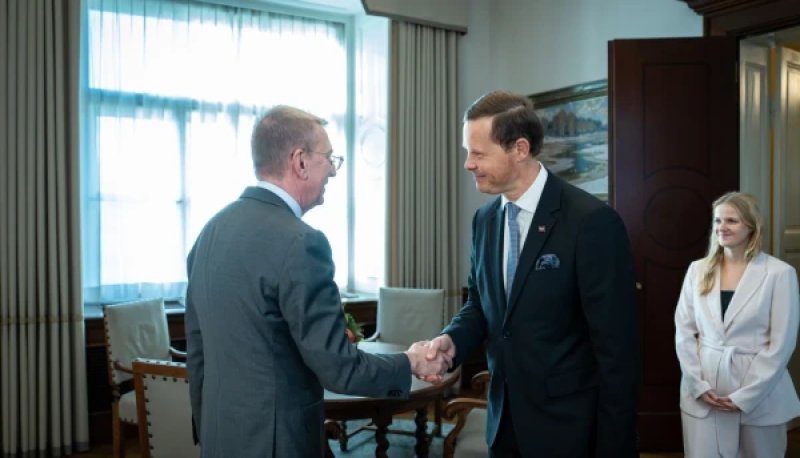
 Foto: BB.LV / Эдгар Ринкевич и Нормунд Станевич
The head of state listened to the minister's plans for fulfilling the tasks outlined in the government declaration, including improving the accessibility of medical services and addressing healthcare financing issues. ### Spending on healthcare needs to be done cautiously Rinkēvičs acknowledged that the government's intention to review state expenditures to reduce the budget deficit is quite understandable. However, he stated that authorities must simultaneously demonstrate real progress in fulfilling the promises made to society. The president placed special emphasis on medical services and medications that allow people to maintain their ability to work, stay longer in the labor market, and continue economic activities. Rinkēvičs emphasized that patient organizations, doctors, and hospital representatives constantly draw attention to serious problems in Latvian healthcare. Among them are insufficient funding, a shortage of medical personnel, long waiting times for specialists, and limited access to medications. ### Funding for previously made decisions must be found The president reminded that healthcare problems have accumulated over the years and require a consistent solution. He drew the minister's attention to healthcare decisions that had already been made by the government and the Saeima. To implement them, funding must be provided in the state budget for 2027 and subsequent years. Additionally, Rinkēvičs called for the continuation of the hospital network reform and for finding solutions to streamline the payment system for medical workers. ### The minister promises to reduce waiting times According to the Ministry of Health, Normunds Staņevičs emphasized during the meeting that the patient should be at the center of all transformations. He stated that quality and timely medical care should be accessible to every resident of Latvia, regardless of their place of residence. Among his priorities, the minister mentioned reducing the waiting time for medical services, strengthening the role of family doctors, and improving interaction between healthcare institutions. Another important task is to create a sustainable healthcare financing model that will make the system more understandable and effective for patients. During the meeting, the preparation of medical specialists, the development of digital solutions, and the long-term resilience of the healthcare system were also discussed. The president and the minister agreed that successful transformations are impossible without close cooperation between government institutions, hospitals, universities, and professional organizations in the medical field. However, specific changes in the system of reimbursable medications and the timelines for their implementation have not yet been announced following the meeting.
