

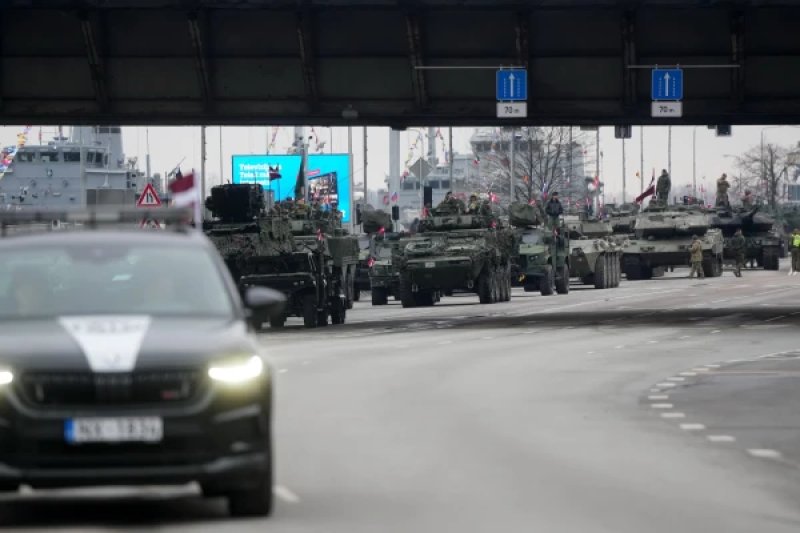
 Foto: BB.LV / Выставка достижений военного хозяйства.
## Figured Out by Nine As stated in the document from the Ministry of Finance published on the legal acts portal, our country has officially joined the ranks of nine founding countries of a new international financial institution — the Defense, Security, and Resilience Bank (DSRB). The declaration of intent to create this bank was signed in July of this year at the NATO summit in Ankara with the participation of Canada, Albania, Belgium, Greece, Latvia, Luxembourg, Romania, Turkey, and Ukraine. The full operation of the structure is planned to be launched in 2027. The main goal of the DSRB is to eliminate the funding gap in the defense sector by attracting both public and private capital. Commercial banks often avoid lending to manufacturers of weapons and military equipment due to strict internal regulations. The new bank is intended to serve as a financial lever: relying on state guarantees from the member countries and a high credit rating (target level — AAA), it will be able to attract cheap funds in global markets and direct them towards strengthening the defense industry. ## Our Contribution to Defense How much money is Latvia investing? According to Appendix A to the bank's charter and the Cabinet of Ministers' decision from June 30, 2026, the total quota for the country (subscribed capital) is fixed at 210 million euros, or 210,000 shares. This means the nominal value of one share will be one thousand euros. However, this does not mean that the entire amount will be taken from the state budget at once or even in installments. As with other major international development institutions (such as the World Bank or EBRD), the capital of the DSRB is divided into two fundamentally different parts: **Paid-in capital** — 20%. This is real money that Latvia is obligated to transfer to the bank's accounts. According to the government's decision, this amount cannot exceed 42 million euros. These funds will serve as the financial base for the bank's operational activities. **Callable capital** — 80%. This is the remaining 168 million euros, which are not transferred to the bank immediately and serve as a state guarantee. These funds may only be required in an emergency — if the bank is on the verge of default and cannot meet its obligations to creditors. Under normal bank operations, they are not transferred. ## Who Benefits It is expected that, with paid-in capital and guarantees from the founding countries, the DSRB will issue bonds and attract private investors' funds in amounts several times greater than the actual contributions of the states. Thus, by investing 42 million euros, Latvia opens access to financing for the defense industry, manufacturers of dual-use products, and infrastructure projects, the volume of which can far exceed the amount of the actual contribution. Thanks to the bank's high credit rating, Latvian defense companies and state structures will be able to obtain long-term loans and guarantees at lower rates than in the regular commercial market.
