

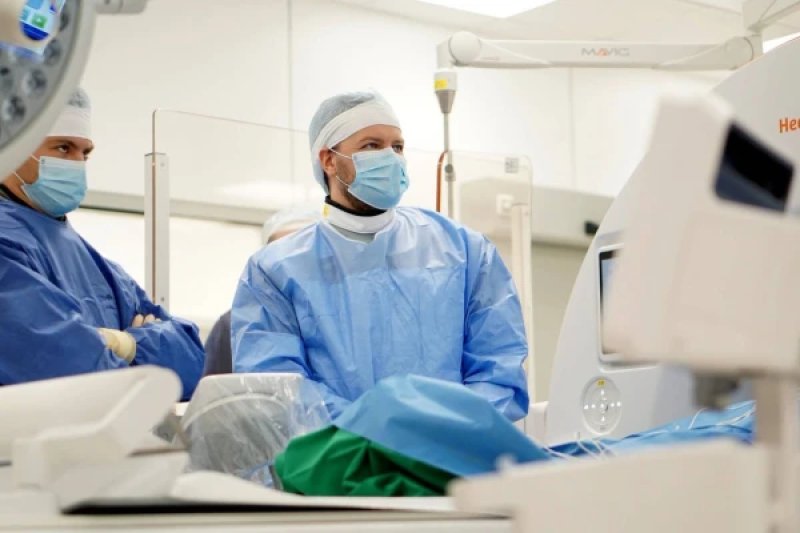
 Foto: BB.LV / врачи
The first patient to undergo such a procedure in Latvia was a person with a colorectal cancer metastasis in the liver. ## How Does Electricity Help Fight Tumors? The procedure was performed in the invasive radiology department of the "Gaiļezers" hospital under computed tomography control. The essence of the method is that special electrodes are inserted into the tumor area. The short electrical impulses they create temporarily increase the permeability of cancer cell membranes, allowing the drug to penetrate more easily and act more effectively on them. Thus, unlike methods that destroy tumor tissues through heating or freezing, electrochemotherapy combines the action of medication and electrical impulses. The precision of the procedure is particularly important. Computed tomography allows doctors to monitor the positioning of the electrodes relative to the tumor, surrounding organs, and blood vessels. ## The Method Is Well-Known, but Its Applications Are Expanding Electrochemotherapy has been used in global medical practice for treating superficial tumors since 1991. However, its application for targeting tumors in internal organs is a relatively new direction. The first clinical studies of the method for liver metastases began in 2009. Since 2023, as part of the international RESPECT study, specialists are collecting data on the effectiveness and safety of electrochemotherapy for treating liver tumors. The introduction of this technology in Latvia marks another step in expanding the capabilities of local oncological care. READ MORE >> [Reconstruction of the Latvian Oncology Center Has Begun - 22 Departments Relocated](https://bb.lv/statja/nasha-latvija/2026/07/08/nacalas-rekonstrukciia-latviiskogo-onkologiceskogo-centra-peremeshheno-22-otdeleniia) ## Who Can Benefit from Electrochemotherapy? The new method is particularly significant for patients for whom surgical intervention is impossible due to the tumor's location or other medical circumstances, or for those who cannot undergo traditional ablation methods. "Patients often ask: is there any other treatment option? In certain situations, electrochemotherapy may become one of them," explains the head of the invasive radiology department at the Eastern Hospital, Aina Kratovska. However, electrochemotherapy is not a universal substitute for surgical intervention or conventional chemotherapy. It is intended for local action on the tumor and can complement other types of anti-tumor treatment. The decision on the feasibility of its application is made at a consultation involving doctors from various specialties. As emphasized by invasive radiologist, Doctor of Medical Sciences Nauris Zdanovskis, the main task remains to achieve specific benefits for the patient — whether it is improving control over the tumor or reducing symptoms caused by the disease. ## When Will the Results of the First Procedure Be Known? In the electrochemotherapy procedure, invasive radiologists Nauris Zdanovskis and Roberts Naglis, nurse Anželika Ursulāna, nurse assistant Irina Janusevska, anesthesiologist Alexey Chesnakov, and nurse-anesthetist Sandra Groza participated. After the procedure, the patient's condition was stable, and he had no complaints. However, it is not possible to assess the impact of electrochemotherapy on the tumor immediately. Specialists will be able to determine the first treatment results in about one to two months. For Latvian medicine, the significance of the procedure lies primarily in the fact that doctors now have another treatment tool in complex oncological cases where the possibilities of using other methods are limited.
