

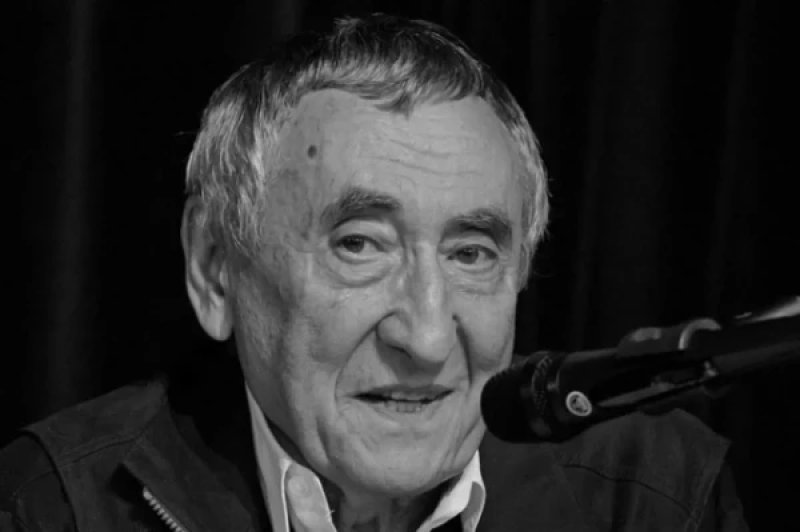
 Foto: BB.LV / Александр Каневский
Alexander Semyonovich Kanievsky was born on May 29, 1933, in Kyiv. He graduated from school with a gold medal, but was not accepted into Kyiv University. Kanievsky graduated from the Kyiv Automobile and Road Institute and was assigned to Kzyl-Orda. There, he worked on the construction of his first bridge and wrote his first play. Upon returning to Kyiv, he wrote programs for the duet of Yuri Timoshenko and Yefim Berezin, "Tarapunka and Shtepsel," as well as scripts for animated films, plays, and screenplays. His texts were published in "Literary Gazette," "Krokodil," "Youth," "Ogonёk," and other publications. **"Cabaret '13 Chairs'"** The most famous page of his biography became his work for "Cabaret '13 Chairs.'" This humorous television show was one of the most popular in the USSR. Kanievsky was among the scriptwriters. The show aired on Central Television from 1966 to 1980. The action took place in a Polish café, and the regulars were mainly played by artists from the Moscow Satire Theater. Pani Monika was played by Olga Aroseva, and Pan Votek was played by Mikhail Derzhavin. Mikhail Derzhavin referred to "Cabaret" as "the first people's television show with permanent characters." Many considered it almost a "window to Europe." Sketches, monologues, and interludes for the beloved characters were written by various authors, and Kanievsky was one of them. He later recalled that in those years, about four hundred of his works were registered with the Copyright Agency. Most of them were performed on stages and platforms throughout the Soviet Union: plays, sketches, monologues, parables. In addition, Kanievsky appeared on the show "Around Laughter," wrote for "Fitil" and "Good Morning." He founded the theater "Grotesque" in Moscow and directed it until his move to Israel in 1991. Throughout his life, Alexander Kanievsky wrote more than 20 novellas, collections of short stories, plays, and reports. Their total circulation exceeded one million copies. Kanievsky was a laureate of the Aleko competition, the Moscow International Film Festival, and the Yuri Nagibin Prize, and was also awarded the Franz Kafka Golden Medal.
